
Library · Standards · File 17
Water conservation systems: what a tank actually delivers, and what a standard actually requires
Rainwater tanks reach near-total reliability for toilet and laundry demand but stay under 85% for irrigation even at 100 m³ — and treated reuse water has to clear numeric NSF/ANSI 350 thresholds untreated catchment never has to meet. Türkiye's 2025 zoning amendment now makes both systems mandatory on qualifying buildings.
Last reviewed — First publication; figures checked against Preeti & Rahman's 2021 Water study of rainwater-tank reliability across eight Australian capital cities, Chowdhury & Akter's 2026 Scientific Reports study of university rainwater harvesting, NSF/ANSI 350's published Class R/C effluent thresholds, ARCSA/ASPE/ANSI 63-2020's rainwater catchment design standard, EN 16941-1's rainwater-system sizing method, and Türkiye's Planlı Alanlar İmar Yönetmeliği amendment (Official Gazette No. 32838, 11 March 2025)
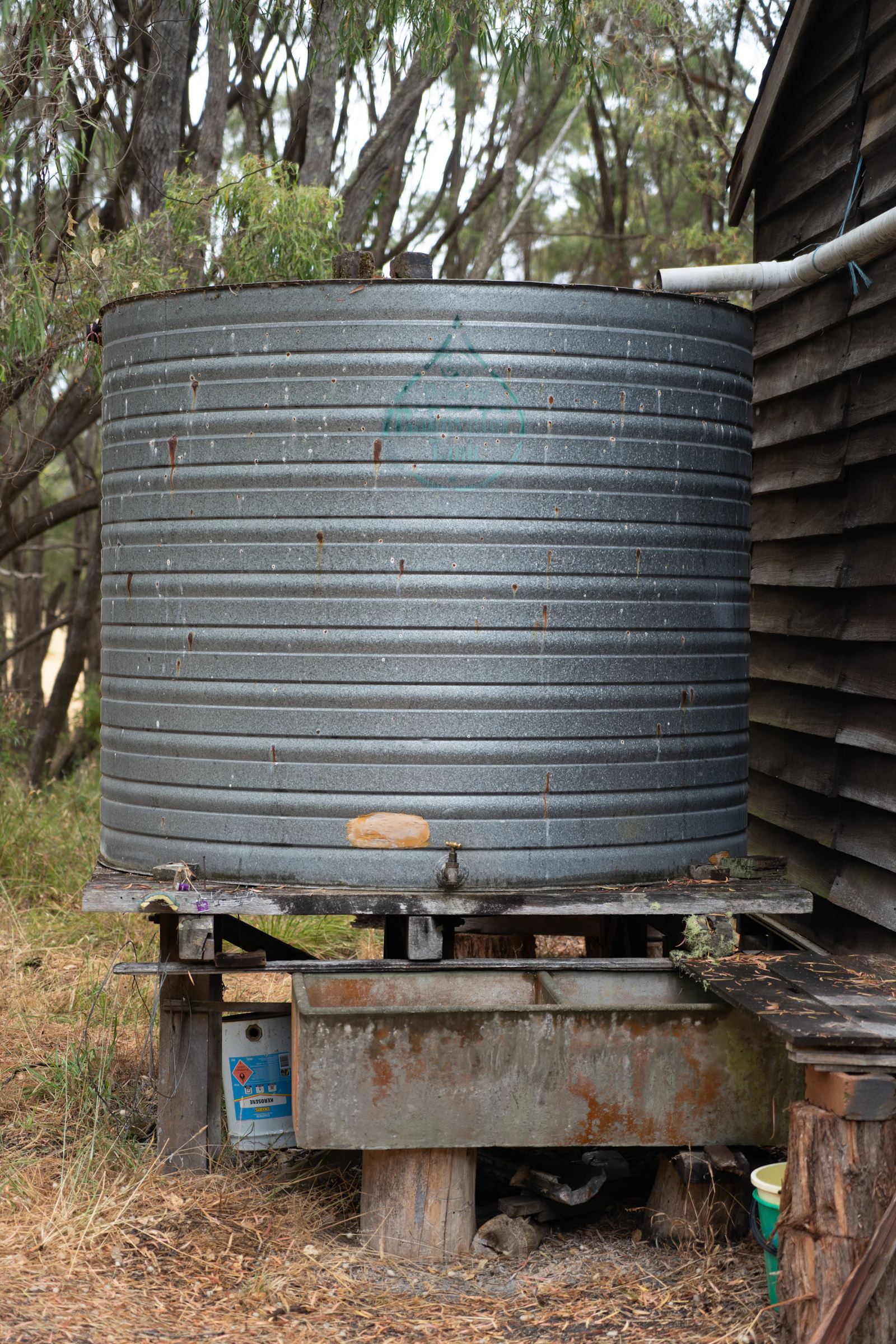
Hc Digital · Unsplash License
Rainwater reliability at 15 m³: toilet+laundry 99%, irrigation 64% (8-city average) · At 100 m³, irrigation reliability still below 85% · NSF/ANSI 350 Class C: turbidity ≤2 NTU avg, E. coli ≤2.2 MPN/100mL geomean · Türkiye Madde 57/A: rainwater storage ≥6% of annual collectible volume, greywater storage ≥50% of connected demand · Combined savings target ~10 million m³/year
This site already covers rainwater harvesting and greywater reuse as short Signals-section pieces — tank-sizing rules of thumb, first-flush diverters, branched-drain layouts. This file is different in kind. It works through the treatment-quality standard a system's output actually has to meet before it counts as "reused water" rather than simply diverted water, the catchment design standard that governs an untreated rainwater system, independent reliability data showing how much of a real annual demand a tank can cover even when it is generously sized, and a binding regulatory change in Türkiye that, from 2026, makes both systems mandatory on qualifying buildings rather than optional best practice. None of this replaces the Signals pieces' practical tips; it answers the harder question underneath them.
How far a tank actually gets you: the reliability curve#
A 2021 peer-reviewed study (Preeti & Rahman, Water 13(19):2606) modelled rainwater-tank reliability across eight Australian capital cities using a consistent 200 m² roof area, comparing two demand types: toilet-and-laundry use (small, steady, indoor) and garden irrigation (large, seasonal, outdoor). For toilet-and-laundry demand, reliability climbs fast and flattens: a 1 m³ tank already covers 71% of demand across the eight-city average, a 5 m³ tank covers 93%, and a 15 m³ tank covers 99% — each additional cubic metre buying less than the one before it. Irrigation demand behaves completely differently. A 1 m³ tank covers 52% of irrigation demand on average, and a 15 m³ tank — fifteen times the storage — only reaches 64%. The paper's own finding is stark: even at a 100 m³ tank, system reliability for irrigation stays below 85% in every city studied. No amount of storage closes that gap, because the constraint is not tank volume but the seasonal mismatch between when rain falls and when a garden needs water.
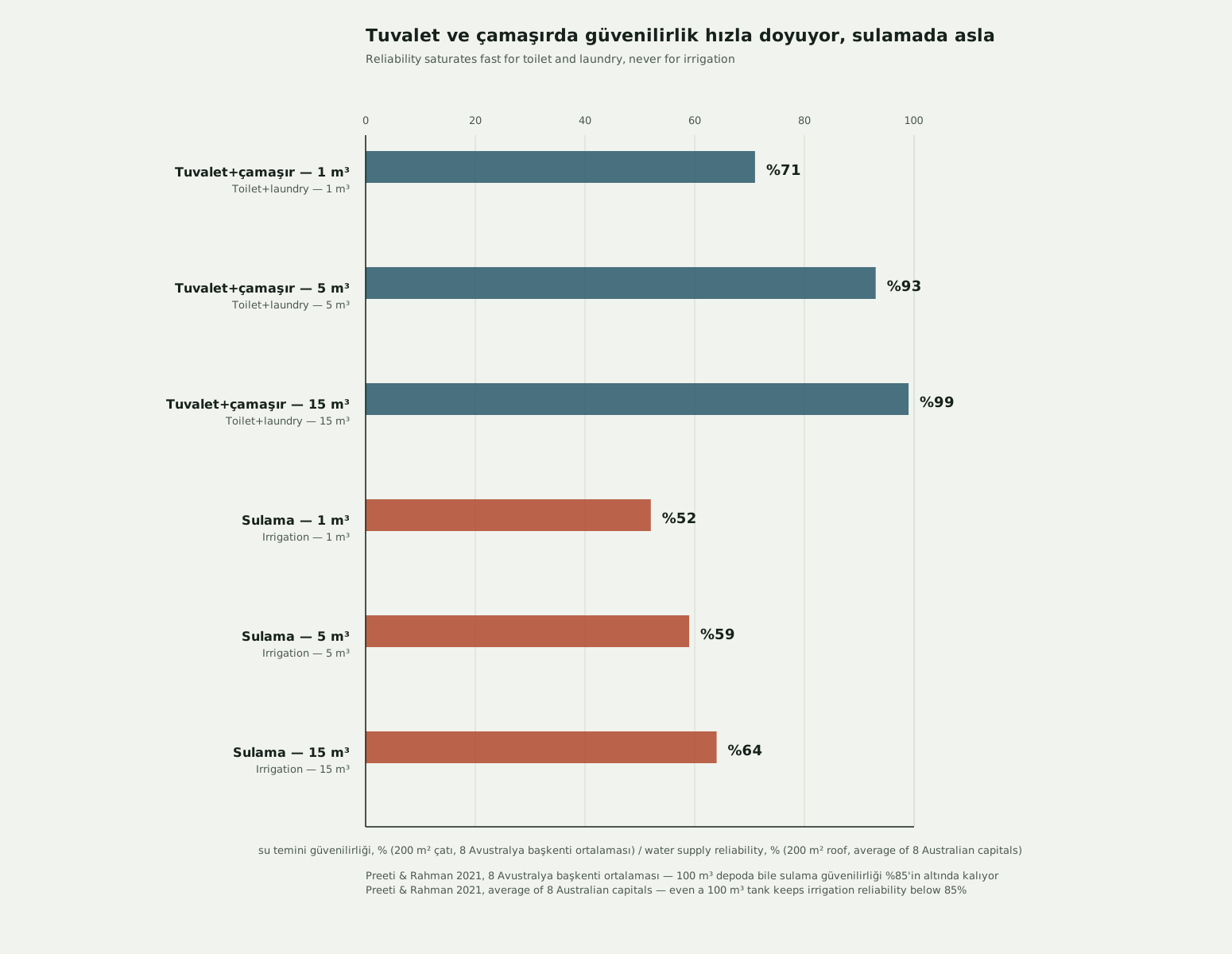
The honest reading of Figure 1 is not "bigger tanks don't help" — they do, especially for indoor, predictable demand. It is that a tank's usefulness depends entirely on what it is being sized against. Toilet-and-laundry demand is small and steady enough that a modest tank can nearly eliminate the gap; irrigation demand is large and concentrated in the dry season, so even a generous tank only ever offsets part of it. The eight-city spread makes the same point locally: at a 10 m³ tank, toilet-and-laundry reliability ranges from 88% in Darwin to 99% in Sydney, and irrigation reliability ranges from roughly 43–55% in Adelaide to 72–87% in Hobart — climate variability changes the answer as much as tank size does, which is exactly why ARCSA/ASPE/ANSI 63-2020, the catchment design standard behind installations like these, requires sizing calculations to use local rainfall records rather than a generic national default.
Demand scale matters as much as tank size#
A 2026 study (Chowdhury & Akter, Scientific Reports) tested this directly on five academic buildings at a university in Chattagram, Bangladesh, comparing two storage scenarios — rain barrels alone at 50,000 L total, and rain barrels plus underground tanks at 140,000 L total, nearly triple the capacity. For toilet flushing at 100 daily users, water-saving efficiency stayed at roughly 29% in both scenarios — nearly tripling the storage barely moved the number, because the constraint was user demand, not tank size. Cut the user count to 10 and the smaller, 50,000 L scenario alone reached 42% efficiency. Irrigation and vehicle-washing use cases, by contrast, reached 96–100% efficiency at realistic scales — watering a lawn through 4 to 10 dry months, or washing a fleet of cars, is a small enough draw relative to roof catchment that both storage scenarios comfortably covered it. The pattern echoes Figure 1 at a different scale: a rainwater system's real-world payoff is set jointly by tank size and by how large and how steady the demand behind it actually is, and neither number on its own predicts the outcome.
What "treated to reuse" actually means: NSF/ANSI 350's numbers#
Everything above concerns untreated rainwater diverted for toilet flushing, laundry or irrigation — the use case ARCSA/ASPE/ANSI 63-2020 covers, where filtration and first-flush diversion are enough because the water never mixes with wastewater and is not certified for unrestricted contact. Treating greywater or blackwater onsite so its output genuinely counts as reused water is a separate, stricter category governed in the US by NSF/ANSI 350, which sets numeric water-quality thresholds a treatment system's effluent must meet, tested over a 26-week protocol, split into two classes by scale: Class R for single-family residential systems up to 1,500 gallons per day, and the stricter Class C for larger commercial systems.
Table 1 — NSF/ANSI 350 effluent quality thresholds#
| Parameter | Class R (residential) | Class C (commercial) |
|---|---|---|
| CBOD₅ (avg / max) | 10 / 25 mg/L | 10 / 25 mg/L |
| TSS (avg / max) | 10 / 30 mg/L | 10 / 30 mg/L |
| Turbidity (avg / max) | 5 / 10 NTU | 2 / 5 NTU |
| E. coli (geomean / max) | 14 / 240 MPN/100 mL | 2.2 / 200 MPN/100 mL |
The gap between the two classes is smallest on organic load and largest on the two parameters that actually govern human contact risk: turbidity and E. coli. Class C's turbidity ceiling is less than half of Class R's, and its bacteriological limits are roughly six times stricter — a deliberate design choice, since a larger commercial system serves far more people and a single treatment failure has proportionally larger consequences. Neither class is a rubber stamp: a system has to hold these numbers across a sustained multi-week test, not on a single good day, which is the actual difference between a certified water-reuse system and a greywater setup that simply looks clean.

Türkiye: a specific, dated mandate#
Türkiye's Planlı Alanlar İmar Yönetmeliği (Planned Areas Zoning Regulation) was amended on 11 March 2025 (Official Gazette No. 32838), adding Article 57/A, which makes rainwater and greywater systems mandatory — not optional — on qualifying buildings. The rainwater provision applies to parcels over 2,000 m², buildings with a roof footprint over 1,000 m², or any building where the required storage volume exceeds 7 m³; the required tank capacity must cover at least 6% of the site's annual collectible rainwater volume, calculated to EN 16941-1 using the province's average annual rainfall and the roof's own characteristics — a real, standards-referenced sizing method rather than a flat number.
The greywater provision targets a different scale of building entirely: accommodation facilities with more than 200 beds, shopping centres over 10,000 m² of construction area, and public buildings over 30,000 m² (healthcare and education facilities excluded). Required storage must cover at least 50% of the daily toilet-flushing demand connected to the system — a design target set directly against the parts of Figure 1 and the university study above that already showed toilet demand is the use case a modest storage fraction can realistically cover. Reported figures put the combined annual water-saving target at roughly 6.2 million m³ from rainwater systems and 4 million m³ from greywater systems — call it on the order of 10 million m³ a year once compliant buildings are in place, though secondary reporting on the exact compliance date is not fully consistent and the regulation's own text should be checked directly for any given project rather than relying on a news summary.
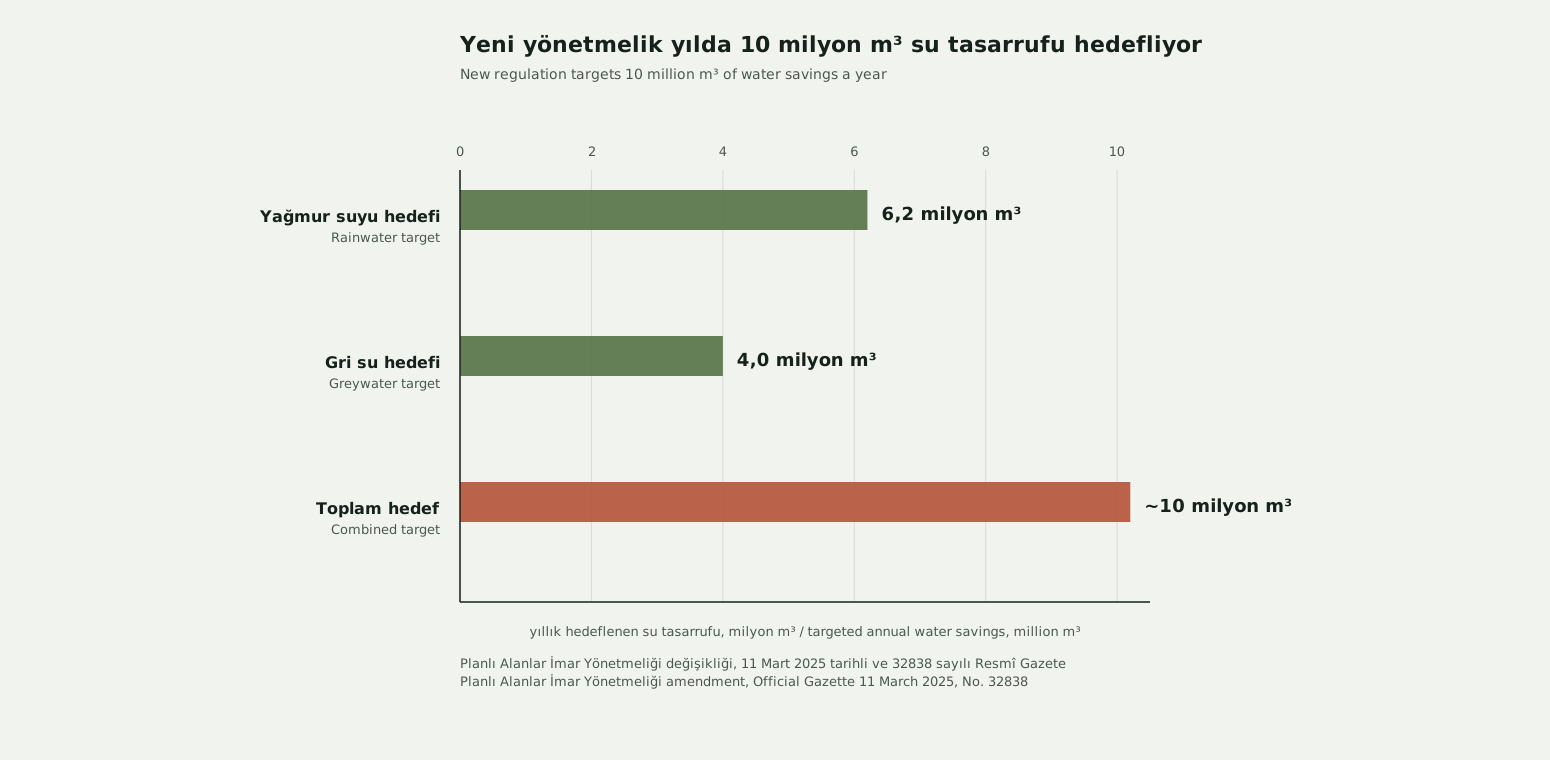
The provision's own compliance timeline is worth verifying case by case: most press coverage cites 1 January 2026 as the date these systems become a prerequisite for occupancy permits, while at least one legal-text summary of the same amendment reads the storage-installation requirement itself as taking effect 1 January 2027, with a related green-certification requirement (YeS-TR) starting 1 January 2026. Treat the Official Gazette text (No. 32838, 11 March 2025) as the authority for any specific project rather than either secondary summary.
- Untreated rainwater diversion (ARCSA/ASPE/ANSI 63) and certified treatment-for-reuse (NSF/ANSI 350) are two different regulatory categories — a rainwater tank feeding a toilet cistern does not need Class R/C certification, but an onsite greywater or blackwater treatment plant does.
- Reliability plateaus fast for small, steady demand (toilet, laundry) and never plateaus for large, seasonal demand (irrigation) — size the system against the demand curve, not a single storage target.
- Nearly tripling storage barely moved water-saving efficiency in the university study once user count, not tank size, became the binding constraint — a system sized for the wrong variable wastes capital regardless of how large the tank is.
- Secondary Turkish-language reporting on the 2025 amendment's exact compliance date is not fully consistent between sources — verify against the Official Gazette text directly for any project subject to it.
None of this argues against rainwater harvesting or greywater reuse — both are real, standards-backed practices with genuine water savings, and Türkiye's new mandate is a substantial, dated regulatory commitment rather than a voluntary gesture. What the evidence argues for is precision about which layer of the system a given number describes: a catchment-design standard is not a treatment-quality standard, a reliability percentage depends entirely on which demand it is measured against, and a storage-capacity rule only delivers its intended saving when it is sized against the actual demand behind it, not against a generic target borrowed from a different building type.
Open knowledge — CC BY-SA 4.0. Copy it, correct it, cite it.
Related in the library
Share this