
Library · Standards · File 20
Life cycle assessment: the methodology behind every carbon number in this series
ISO 14040/44 and EN 15978 give building carbon claims a genuine, auditable methodology — but a contested optional module, a peer-reviewed case study where database choice alone moved results by up to 159%, and Türkiye's brand-new, not-yet-binding certificate requirement all show that "we ran an LCA" is the start of a question, not the end of one.
Last reviewed — First publication; figures and claims checked against ISO 14040:2006, ISO 14044:2006, EN 15978, EN 15804+A2, RICS's Whole Life Carbon Assessment for the Built Environment (2nd edition, July 2024), Keyhani et al.'s 2023 Sustainability study, and the 16 May 2026 amendment (Official Gazette No. 33255) to Türkiye's Binalarda Enerji Performansı Yönetmeliği
Julia Taubitz · Unsplash License
Keyhani et al. 2023: material-level embodied carbon varied 50–159% by database choice on the same UK house · whole-life split for that house: 67% operational / 31% embodied / 2% end-of-life over 50 years · Türkiye: Building Life Cycle Analysis Certificate mandatory ≥10,000 m² from 1 Jan 2027 (Official Gazette No. 33255, 16 May 2026) · RICS WLCA 2nd edition effective 1 July 2024
Every embodied-carbon figure cited elsewhere in this series — the 43% reduction in File "carbon-43," the 58 vs. 147 kgCO2e/m² comparison in File 18, the whole-life carbon caps in File "policy-2027" — ultimately traces back to someone running a life cycle assessment (LCA). This file turns the lens on that methodology itself. LCA is not a single number; it is a calculation procedure, and the procedure has a generic international standard, a building-specific European standard built on top of it, a genuinely contested optional module, and a fast-evolving professional standard that changed substantially as recently as 2024. Understanding how an LCA is built is what lets a reader tell a rigorous whole-life carbon claim from a selectively-scoped one.
One generic standard, four phases: ISO 14040 and 14044#
The foundation of every LCA, in any industry, is ISO 14040:2006 and its companion ISO 14044:2006. Neither standard is specific to buildings or even to construction — they define the generic principles and requirements for assessing the environmental impact of any product across its life cycle. Together they set out four phases: goal and scope definition (what is being assessed, and within what system boundary), life cycle inventory analysis (compiling every material and energy input and output across that boundary), life cycle impact assessment (translating that inventory into environmental impact categories such as global warming potential), and interpretation (drawing conclusions and identifying the assessment's own limitations). ISO 14040/44 does not specify how to apply this to a building — that is EN 15978's job — but every building-specific standard that follows sits on top of this same twenty-year-old four-phase skeleton.
Building-specific: EN 15978 and the module system#
EN 15978, published by CEN, applies ISO 14040/44's generic framework specifically to buildings and introduces the module system used throughout this series (already referenced in the whole-life carbon figures of Files "carbon-43," 13 and "policy-2027"). The building's life cycle is broken into lettered modules, each covering a distinct stage, so that a reported figure can specify exactly which stages it includes rather than an unqualified "embodied carbon" number that could mean almost anything.
Table 1 — The EN 15978/15804 module system#
| Modules | Stage / status |
|---|---|
| A1–A3 (Product) | Raw material supply, transport to manufacturer, manufacture — "cradle to gate," the scope most EPDs cover |
| A4–A5 (Construction) | Transport to site, installation into the building |
| B1–B5 (Use) | Use, maintenance, repair, replacement, refurbishment |
| B6–B7 (Operational) | Operational energy use, operational water use |
| C1–C4 (End of life) | Deconstruction/demolition, transport, waste processing, disposal |
| D (Beyond system boundary) | Net benefits from reuse, recycling or energy recovery — mandatory to calculate, mandatory to report separately, never summed with A–C |
Module D: calculate it, but never add it in#
Module D is the most genuinely contested part of the whole system, and it deserves to be named as a live methodological debate rather than a settled fact. EN 15804 (and its US/international counterpart, ISO 21930) requires Module D to be calculated and disclosed in an EPD — but it also explicitly requires it to be reported separately, never aggregated into the same total as Modules A–C. Three criticisms explain why. First, Module D estimates a future benefit — the avoided burden of not needing virgin material because this product will eventually be recycled — using today's environmental data, even though the industrial processes it is crediting are themselves expected to decarbonize substantially by the time that recycling actually happens; critics argue this systematically overstates the benefit. Second, Module D only credits the recovery of primary (virgin) material; a product already made from 100% recycled content shows essentially no Module D benefit when it is recycled again, which undercounts genuine circular-economy performance rather than rewarding it. Third, and most practically: when a headline "net zero" or "carbon neutral" claim folds Module D's projected future credit into the same number as measured A–C impacts, the claim can look considerably better than the building's actual, already-incurred carbon footprint — which is exactly the kind of unqualified adjective this series treats with suspicion until the underlying module scope is stated.
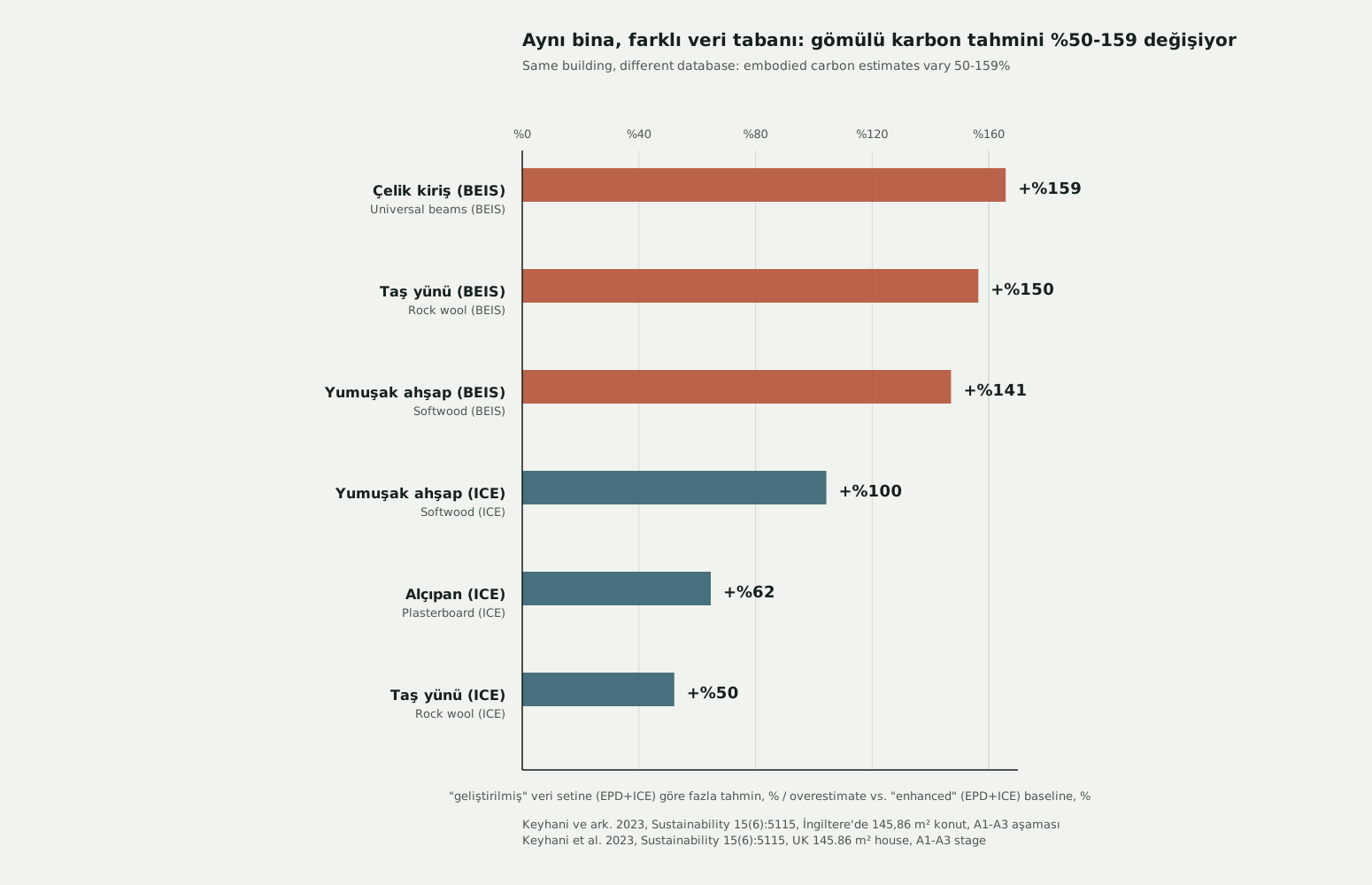
How much does database choice actually matter in practice? A 2023 peer-reviewed study (Keyhani, Nauta et al., Sustainability 15(6):5115) assessed the same real UK residential building — a 145.86 m² two-storey detached house with a timber roof and concrete block walls — using four different embodied-carbon data sources for the A1–A3 product stage: manufacturer-specific Environmental Product Declarations, the UK's Inventory of Carbon and Energy (ICE) database, the UK government's BEIS database, and an "enhanced" dataset that used EPDs wherever available and fell back to ICE only where no EPD existed. Against that enhanced baseline, the generic databases diverged sharply by material: ICE overestimated softwood by 100% and plasterboard by 62%; BEIS overestimated structural steel universal beams by 159% and rock wool by 150%. This is not a case of one bad dataset — ICE and BEIS are both legitimate, widely used UK references — it is a demonstration that an EN 15804-compliant, methodologically correct LCA can still produce a materially different headline number purely from which generic database filled the gaps an EPD didn't cover.
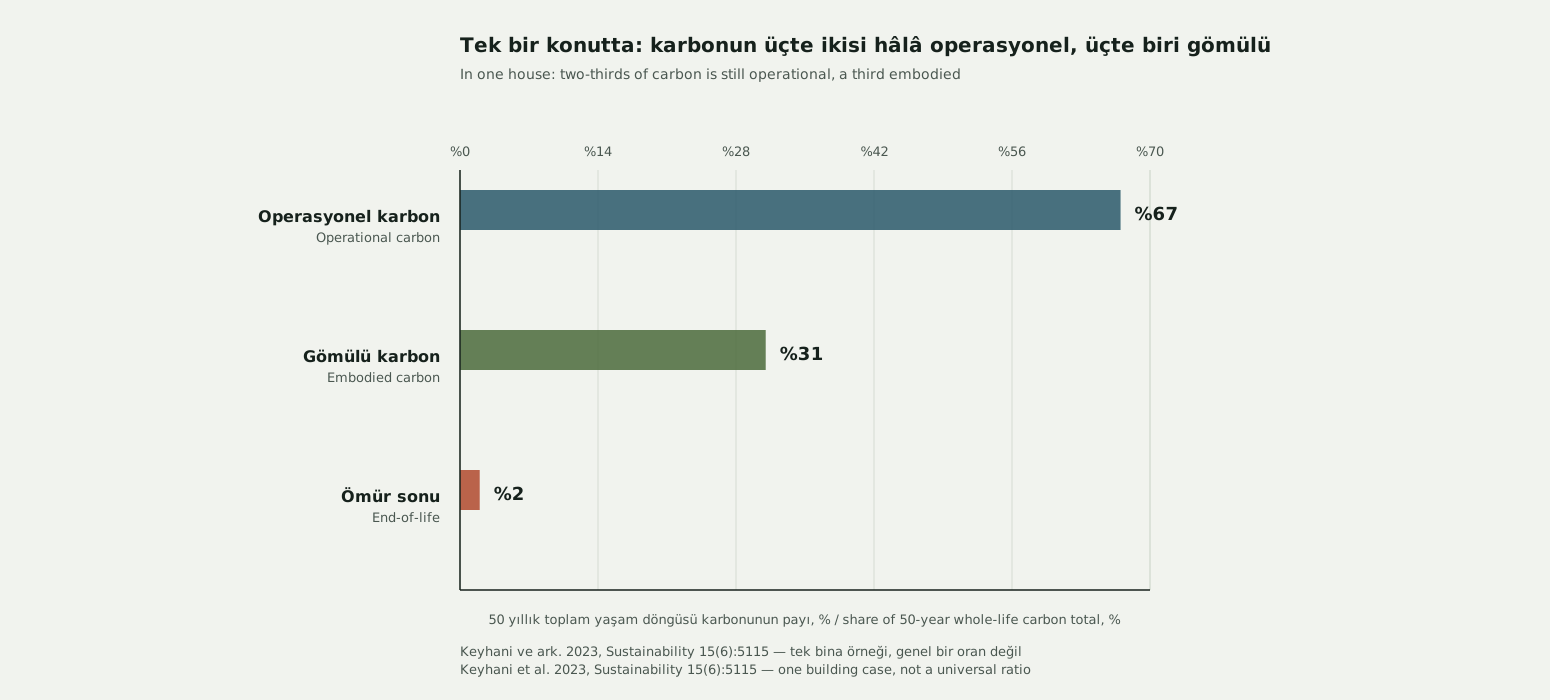
The same study's whole-building result is worth stating precisely, and worth not over-generalising. Using the enhanced database together with RICS guidance, the case-study house totalled 95.9 tCO2e of embodied carbon against a modelled 169.3 tCO2e of operational carbon over a 50-year study period — a split of roughly 67% operational, 31% embodied and 2% end-of-life. That is a genuinely useful data point, but it describes one specific house with one specific heating system in one specific climate; it is not a universal ratio, and File 13's discussion of grid decarbonisation already establishes why operational carbon's share should be expected to shrink over a building's life as electricity grids clean up, while embodied carbon — locked in at the moment of construction — does not.
RICS Whole Life Carbon Assessment: 2nd edition, July 2024#
Where ISO 14040/44 and EN 15978 are the established, decades-stable backbone, the professional practice standard sitting on top of them is still visibly emerging. RICS's Whole Life Carbon Assessment for the Built Environment moved to a 2nd edition effective 1 July 2024, extending the framework from buildings alone to infrastructure as well, and adding three new reporting stages: Module A0 for pre-construction activities such as surveys and design-stage emissions, Module B8 for in-use activities not captured elsewhere (including occupant commuting and vehicle use, mostly relevant to infrastructure), and a split of Module D into D1 and D2 to separate different categories of end-of-life benefit. The 2nd edition also introduced mandatory contingency allowances and aligned its definitions with the International Cost Management Standards (3rd edition) and the UK's Built Environment Carbon Database. This is genuinely new professional practice — barely two years old at the time of writing — and firms across the industry are still in the process of adopting it, which is worth flagging plainly rather than treating the 2nd edition as though it has already become universal practice.
Türkiye: from energy performance to life cycle performance#
Türkiye's shift here is recent enough to still be unfolding as this is written. An amendment to the Building Energy Performance Regulation (Binalarda Enerji Performansı Yönetmeliği), published in the Official Gazette (No. 33255) on 16 May 2026, formally introduces a "Building Life Cycle Analysis" (Bina Yaşam Döngüsü Analizi) requirement — and, notably, the amendment explicitly names TS EN ISO 14040 and TS EN 15978 as the required methodology, directly adopting the same two standards this file has just walked through rather than inventing a parallel domestic framework. Buildings of 10,000 m² or more receiving a construction permit must submit a Building Life Cycle Analysis Certificate together with their Energy Performance Certificate at the occupancy-permit stage, with this specific requirement (Articles 6–7) taking effect on 1 January 2027 — all other provisions of the amendment took effect on the publication date itself. A separate, optional "Low-Carbon Building Certificate" (Düşük Karbonlu Bina Belgesi) is available through the BEP-TR platform for buildings that clear both a greenhouse-gas emission class of at least B and an energy performance class of at least C, issued by authorised Energy Performance Certificate specialists. Public-sector construction projects with procurement decisions made before 1 January 2027 are exempted from the life cycle analysis requirement under a transition provision.
This regulation is genuinely new, not a completed case study: as of this writing, the 10,000 m² life cycle analysis requirement does not bind until 1 January 2027, so no Turkish building has yet obtained a Building Life Cycle Analysis Certificate under it, and no real compliance dataset exists to report. That is stated plainly here rather than implied away — this is a live regulatory rollout to watch, not yet a result to cite.

- Module D must be calculated and disclosed, but EN 15804/ISO 21930 require it to be kept separate from the A–C total — a headline claim that quietly folds Module D's projected future benefit into a present-day carbon number should be read with real caution.
- Database choice alone changed material-level embodied carbon estimates by 50–159% for the identical, real UK house in the Keyhani et al. 2023 study — an EN 15804-compliant LCA is not automatically a database-independent one.
- RICS's 2nd-edition Whole Life Carbon Assessment standard is barely two years old at the time of writing and still being adopted across the industry — treat it as current best practice, not yet as universal practice.
- Türkiye's Building Life Cycle Analysis Certificate requirement does not take effect until 1 January 2027 — as of this writing it is a real, dated regulation, but one with no compliance track record yet to point to.
None of this argues against life cycle assessment as a tool — quite the opposite: ISO 14040/44 and EN 15978 give the built environment a genuinely rigorous, internationally recognised way to move past adjectives and into an auditable calculation, and Türkiye's new requirement is a real step toward making that calculation mandatory rather than optional. What the evidence in this file argues for is treating "we ran an LCA" as the start of a question, not the end of one — which standard's module boundary, which underlying database, whether Module D was kept separate, and which edition of which professional standard was followed all change what the resulting number actually means. That is the same discipline this series applies to every other technology in it, turned, this time, on the measurement itself.
Open knowledge — CC BY-SA 4.0. Copy it, correct it, cite it.
Related in the library
Share this