
Library · Standards · File 07
Circular construction and design for disassembly: building things that can be unbuilt
ISO 20887 sets out how to design a building so its parts can be taken apart and reused rather than demolished into rubble. What the Brummen Town Hall pilot actually proved, and why a country that just generated up to 210 million tons of earthquake debris has an unusually direct stake in the answer.
Last reviewed — First publication; figures checked against ISO 20887:2020, the EU Horizon 2020 BAMB project (CORDIS project 642384), the Ellen MacArthur Foundation's Brummen Town Hall case study, Arslan, Coşgun & Salgın (2012) on Turkish C&D waste management, and UNDP Türkiye's 2023 earthquake rubble estimate
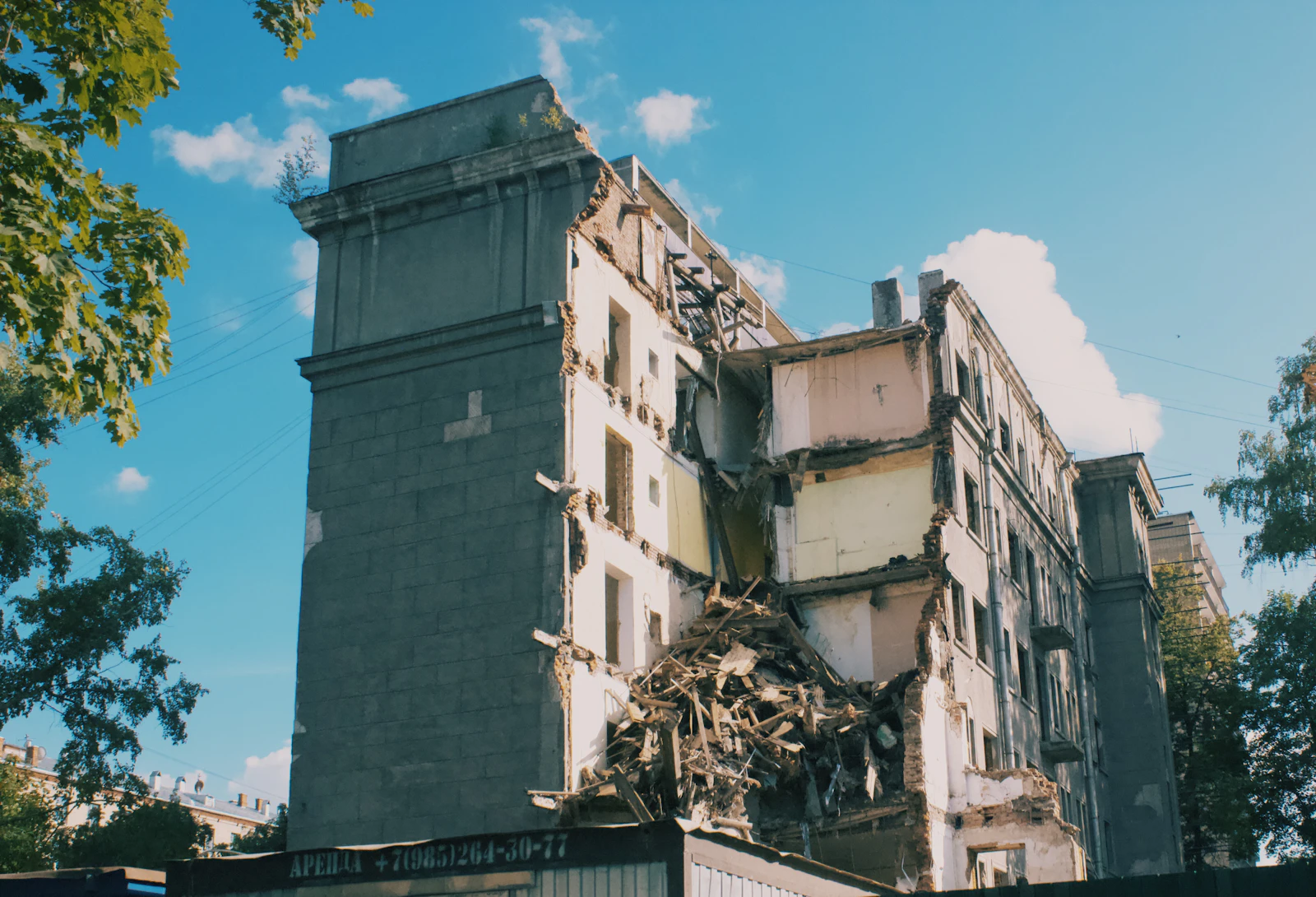
Mikhail Savin · Unsplash License
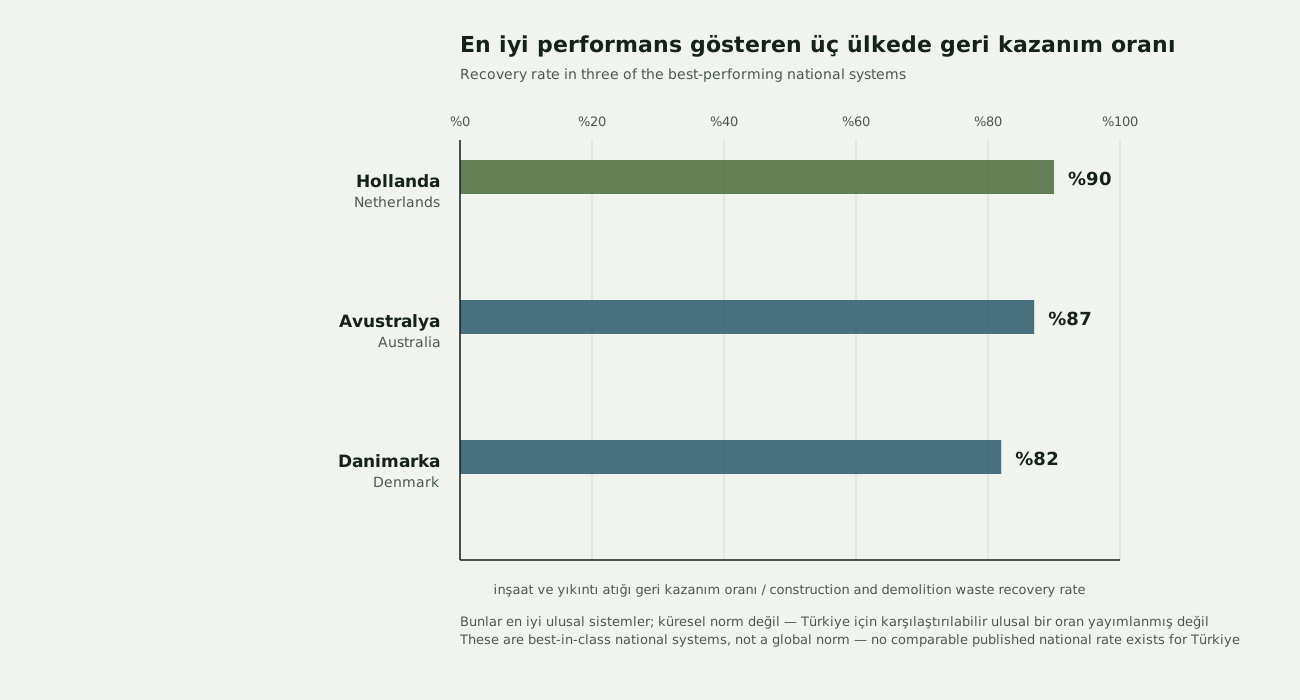
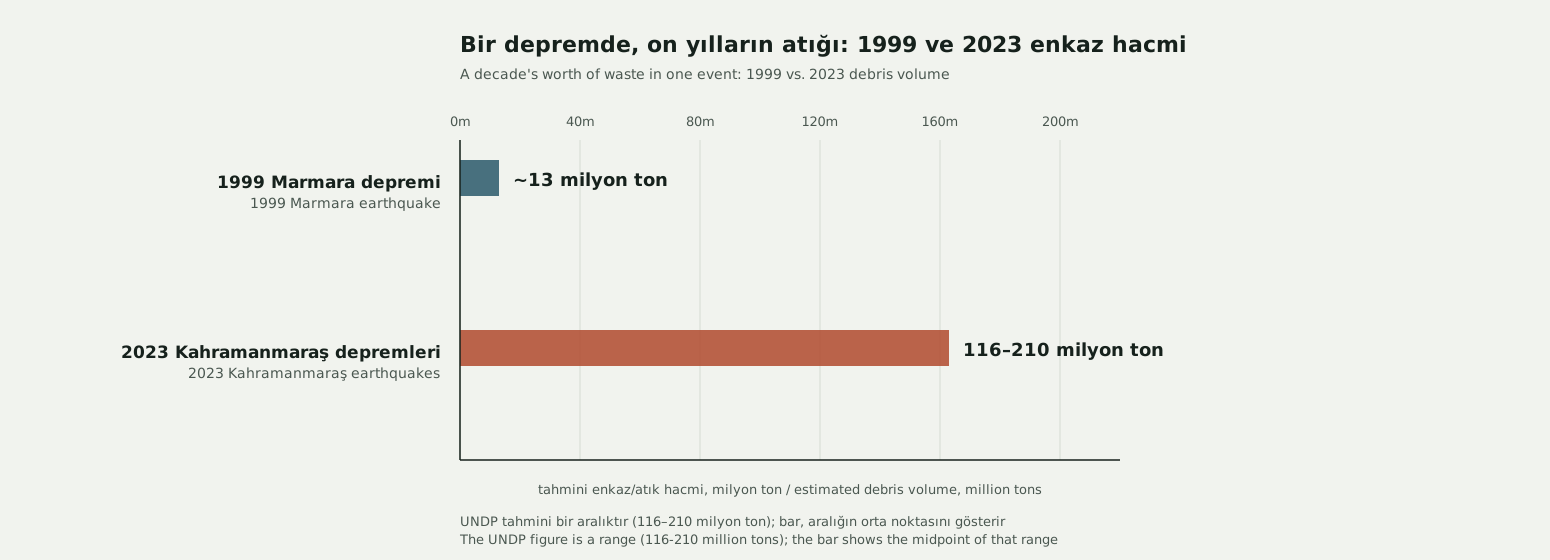
Best-performing national C&D recycling rates: Netherlands 90%, Australia 87%, Denmark 82% · Türkiye's 2023 earthquake debris: an estimated 116–210 million tons, over 10x the ~13 million tons of the 1999 Marmara earthquake
Every building is eventually demolished — the only question is how much of it survives the process. Conventional construction bonds materials together with wet concrete, adhesives and welds that make disassembly essentially impossible, so what comes down goes into a truck as mixed rubble rather than back into a supply chain as components. Circular construction, and the design-for-disassembly (DfD) practice behind it, is the attempt to change that outcome before the building is ever built — by choosing connections and materials that can be undone, not just materials that sound sustainable.
What "design for disassembly" actually means#
The distinction is not about which materials are used but about how they are joined. A wet, chemical or welded connection is designed — whether anyone intended it or not — to be permanent: taking it apart destroys the substrate on at least one side of the joint. A mechanical, reversible connection — a bolt, a screw, a dry-fitted tongue-and-groove — is designed to be undone: the same bolt that assembled the joint can disassemble it, leaving both materials intact. The same steel beam, the same timber panel, the same concrete block can end up in a landfill or in the next building, and the difference is usually decided at the connection detail, not at the material specification sheet.
Table 1 — Conventional vs. reversible connections#
| Approach | Typical connection | Material fate at end of life |
|---|---|---|
| Conventional | Wet concrete, adhesive bonding, welding | Demolition — crushed, landfilled or downcycled as aggregate |
| Design for disassembly | Bolts, screws, dry-fitted mechanical joints | Disassembly — component recovered intact, re-enters supply chain |
How to read it: the right-hand column is the entire economic argument for DfD in one sentence — a recovered component has resale value, a crushed one has disposal cost.
What ISO 20887 actually requires#
ISO 20887:2020 formalizes the reversible-connection principle into design guidance: it directs designers to avoid "poured and welded (wet, chemical, or fixed) connections" because they decrease the potential for disassembly, and to prefer, for example, a tongue-and-groove connection over an adhesive compound that would permanently contaminate the material. It also calls for standardized, repeatable components that a contractor can disassemble with efficient techniques rather than bespoke one-off joints, and for connections to be exposed and accessible — with enough clearance around them — rather than buried where dismantling is impossible without demolition. The standard is principle-based rather than prescriptive: it provides a documentation checklist for design teams rather than numeric performance thresholds, which means compliance is closer to a design discipline than to a pass/fail test.
Material passports and the BAMB project#
Knowing how to disassemble a joint is only useful if someone downstream knows what is inside it. BAMB (Buildings as Material Banks) was an EU Horizon 2020 project that ran from September 2015 to February 2019 with a budget of €9.92 million, coordinated by Brussels Environment, built specifically to solve that information gap. Its central tool is the materials passport: a structured record of what materials and components a building contains, their properties and their condition, so that value can be recovered from them rather than assuming they are worthless once the building is no longer wanted. BAMB tested the concept, together with reversible-design protocols and transformation-capacity assessments, across four pilot construction sites, and published its findings as open research rather than a proprietary product.

A passport is a documentation tool, not a guarantee. It creates value only if there is an actual buyer, market or reuse pathway waiting at the other end — and it has to remain legible, accessible and trusted for as long as the building stands, which is a data-governance problem as much as a design one.
A building that works like a bank: Brummen Town Hall#
The clearest real-world test of these ideas is a town hall in Brummen, the Netherlands, designed by architect Thomas Rau. The municipality commissioned it with a deliberately fixed 20-year service life, anticipating that shifting district boundaries could make the building redundant on a known timeline rather than an open-ended one. The design favoured prefabricated timber elements over hard-to-recycle concrete and was worked out with the supplier specifically to maximize future reuse potential — the architect has described the result as a "Lego-like structure" in which roughly 90% of the materials can be dismantled and reused after those 20 years. The contractor, BAM, backed the design with a guarantee that the building's materials would retain 20% residual value at the end of that life, and the project received what is described as the world's first materials passport — turning the building itself into what Rau calls a "material depot" for whatever gets built next.
How to read it: this is one flagship pilot under a specific contractual arrangement, not evidence that circular construction is now the industry default — most buildings today, including in the markets most invested in circular-economy policy, are still designed, built and eventually demolished the conventional way.
Where circular construction genuinely struggles#
- Standardization pulls against architectural individuality: reversible, repeatable connections are what makes disassembly practical, but the bespoke geometry many architects and clients want resists standardization by definition.
- The cost and skill premium is paid upfront and the payoff arrives decades later: mechanical connections and passport documentation add design time and construction cost today, while the value they unlock is only realized at a demolition that may not happen for 20, 50 or 100 years.
- The secondary materials market is thin almost everywhere: a materials passport only creates value if there is somewhere to actually resell or reuse the recovered component, and most markets — Türkiye's included — lack an organized resale channel for structural building components at any scale.
- Passport data has to outlive its authors: a documentation system created at handover in one decade has to still be legible, accessible and trusted at demolition several decades later — a data-governance and institutional-continuity problem that no connection detail can solve on its own.
Türkiye: a country that just generated decades of debris in seconds#
Türkiye's construction and demolition waste framework has existed since 2004, under the Regulation on the Control of Excavation Soil and Construction and Demolition Waste (No. 25406), which assigns metropolitan municipalities responsibility for waste management plans, recovery facilities and storage sites. Istanbul built a mobile recycling facility with 200 tons per hour of processing capacity in 2008. But the recorded results are modest: municipal data from 2006–2011 shows roughly 1.7 million tons of excavation soil recovered against only about 280,797 tons of construction and demolition waste specifically, and no comprehensive national recycling rate has been published for comparison — unlike the Netherlands, Australia and Denmark, whose national systems recover 90%, 87% and 82% of C&D waste respectively.
The February 2023 Kahramanmaraş earthquakes make that gap concrete rather than abstract. UNDP estimated the disaster generated between 116 and 210 million tons of rubble — more than ten times the roughly 13 million tons produced by the 1999 Marmara earthquake — from over one million inspected structures, of which 156,000 buildings containing 507,000 separate homes and offices were found to require demolition. None of that stock was designed for disassembly; recovery has depended on emergency capacity built after the fact, including a UNDP-backed facility in Hatay processing 500 tons of debris per hour, rather than on anything designed into the buildings before they fell.
The reconstruction now underway is, for the most part, being built the same way as what came before it — conventional, largely non-reversible connections — which means the same debris problem is quietly being manufactured again for whenever this new stock reaches the end of its life, earthquake or no earthquake.
None of this is an argument that factory-made, panelized systems — including the ones this publisher develops — are automatically circular just because they are modular. A panel bonded to a concrete slab with wet mortar is exactly as hard to disassemble as anything built on site; modularity and circularity are different properties, and only the second one depends on the connection detail rather than on where the component was manufactured.
The most useful question to ask about any claim of circularity is not "is it modular or prefabricated?" but "can this connection be undone without destroying the material on either side of it?" — the first question has a marketing answer; the second has a checkable one.
Open knowledge — CC BY-SA 4.0. Copy it, correct it, cite it.
Related in the library
Share this