Library · Standards · File 06
Mass timber: how CLT and glulam turn engineered wood into structure
CLT and glulam solve the same problem — wood's natural size and defect limits — in different geometries. What the standards actually require, what a full-scale shake-table test revealed about connections, and why Türkiye has the timber but almost none of the industry.
Last reviewed — First publication; figures checked against EN 16351 and EN 14080, the SOFIE project shake-table study (Ceccotti et al., Earthquake Engineering & Structural Dynamics, 2013), a 2024 peer-reviewed embodied-carbon case study (Buildings 14(5):1276), and a 2021 Turkish government CLT pre-feasibility report
Josh Olalde · Unsplash License
Mass timber vs. steel embodied carbon: 198 vs 243 kgCO2e/m² in one case study · Türkiye's proposed CLT capacity: 10,000 m³/yr vs 120,000 m³/yr at one European plant
Solid-sawn timber has a structural problem: the bigger the piece, the more likely it contains a knot, a check or a grain defect that limits its strength, and trees only grow so wide before that limit becomes the ceiling for the whole building. Glued laminated timber (glulam) and cross-laminated timber (CLT) solve this the same way — by gluing thin, defect-graded layers of wood together so the engineered product is stronger and more predictable than the tree it came from. Where they differ is what they are built to do.
Two products, one principle#
Glulam layers run parallel to each other, all fibres pointing the same direction — the product behaves like a bigger, more consistent piece of solid timber, and it is used the way solid timber is: as beams and columns carrying load along their length. CLT layers alternate at 90 degrees, typically in three, five or seven plies — the cross orientation is what turns a stack of boards into a rigid panel that can span in two directions and be used as a wall, floor or roof, the way a plywood sheet works but at structural scale.
Table 1 — Glulam and CLT compared#
| Product | Layer orientation | Typically used as | Governing EU standard |
|---|---|---|---|
| Glulam | Parallel — all layers same direction | Beams, columns, long-span members | EN 14080 |
| CLT | Cross-oriented — 3, 5 or 7 layers at 90° | Structural wall, floor and roof panels | EN 16351 |
How to read it: both are engineered from the same raw material — strength-graded softwood boards — and the standard that governs each is different because the product behaves differently, not because one is more "real" wood than the other.
What EN 16351 actually requires#
EN 16351 does not just say "glue boards together" — it sets specific, checkable limits: timber strength-graded to EN 14081-1, only coniferous species and poplar permitted, individual layer thickness between 6 and 47 mm, lamination width between 40 and 300 mm, overall panel thickness capped at 500 mm, and at least three orthogonally bonded layers with controlled moisture content and temperature during pressing. The standard explicitly excludes fire-retardant-treated CLT and panels made from recycled timber — a CLT panel outside these bounds is not covered by the standard's requirements at all, whatever the marketing calls it.

Seismic performance: what the SOFIE test actually showed#
The most-cited real-world evidence for CLT under seismic load is the SOFIE project's 2013 3D shake-table test on a full-scale seven-storey CLT building — at the time the tallest timber building ever tested this way. The building showed self-centring behaviour and high stiffness combined with enough ductility to avoid brittle failure, validating what researchers call an action reduction factor of three for X-lam construction. Critically, the damage that did occur concentrated in the metal connectors and joints at wall bases — the CLT panels themselves showed excellent seismic integrity throughout.
This is the same pattern seen in SIP and modular construction: the engineered panel or module performs well in isolation, and the connection between units is where the structural risk concentrates. The SOFIE researchers themselves flagged higher accelerations in the upper storeys as needing further study — even a well-performing system has open questions at scale.
Fire performance: the predictable failure mode#
Mass timber's fire design does not rely on the wood not burning — it relies on the wood burning predictably. Softwood chars at a well-established rate of roughly 0.65 mm per minute under standard fire exposure; the code path (IBC Section 722, pointing to NDS Chapter 16 in the US) lets an engineer size a structural member with a sacrificial outer layer thick enough to char away during the required fire-resistance period while the inner, uncharred core keeps carrying load. This is a fundamentally different failure mode from steel, which loses strength suddenly and non-linearly as it approaches its critical temperature — timber's char layer is itself an insulator that slows the burn rate of everything beneath it.
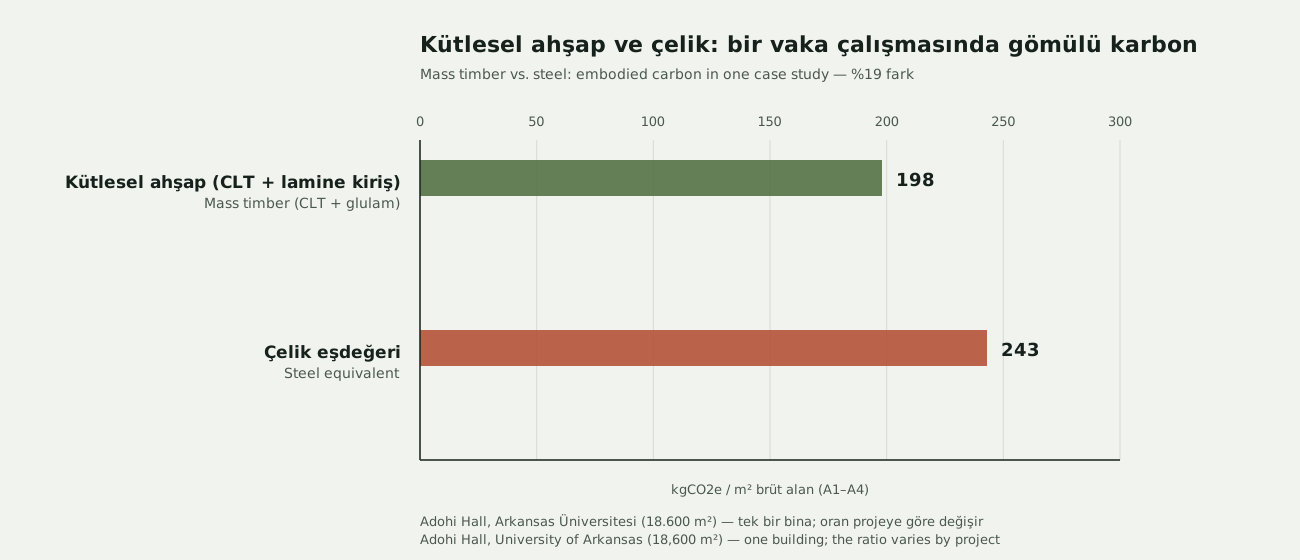
How to read it: this is the A1–A4 structural-material comparison for one building — it does not include the separate, and separately debated, question of how much of the biogenic carbon stored in the wood itself should be counted as a climate benefit, which different life-cycle assessment methodologies treat differently.
Where mass timber genuinely struggles#
- Connections govern the seismic and structural risk: as the SOFIE test showed, the panel material performs well — the metal fasteners, brackets and joints between panels are where engineering attention and cost need to concentrate.
- Moisture management during construction is a documented, active research area: CLT panels exposed to weather before the building is enclosed can absorb moisture that is slow to dry from a closed cross-laminated section, creating conditions for mould or dimensional movement if not actively managed on site.
- Cost and skilled-labour availability vary sharply by region: markets with an established mass-timber supply chain and trained installers see competitive costs against concrete and steel, while markets without one — including most of Türkiye — face both higher landed costs and a shortage of contractors experienced with the material.
- Panel size is a transport and crane decision as much as a design one: a full CLT panel can weigh several tonnes, and the practical maximum size is set by what a truck and crane combination can move and lift on a given site, not by the factory press.
Türkiye: the wood, but not yet the industry#
Türkiye has the raw material for CLT — Scots pine, fir and Eastern spruce are all naturally available domestic softwoods suitable for the product — but essentially no domestic production industry: a 2021 government pre-feasibility study for a proposed facility in Yozgat found only one small-scale CLT producer operating in the country, in Antalya. The proposed Yozgat facility would add 10,000 m³ of annual capacity for a fixed investment of roughly 70 million lira, against a single established European CLT plant in Czechia that reached approximately 120,000 m³ of annual capacity after ramp-up — a twelvefold difference in scale between a single foreign plant and Türkiye's still-unbuilt proposal.
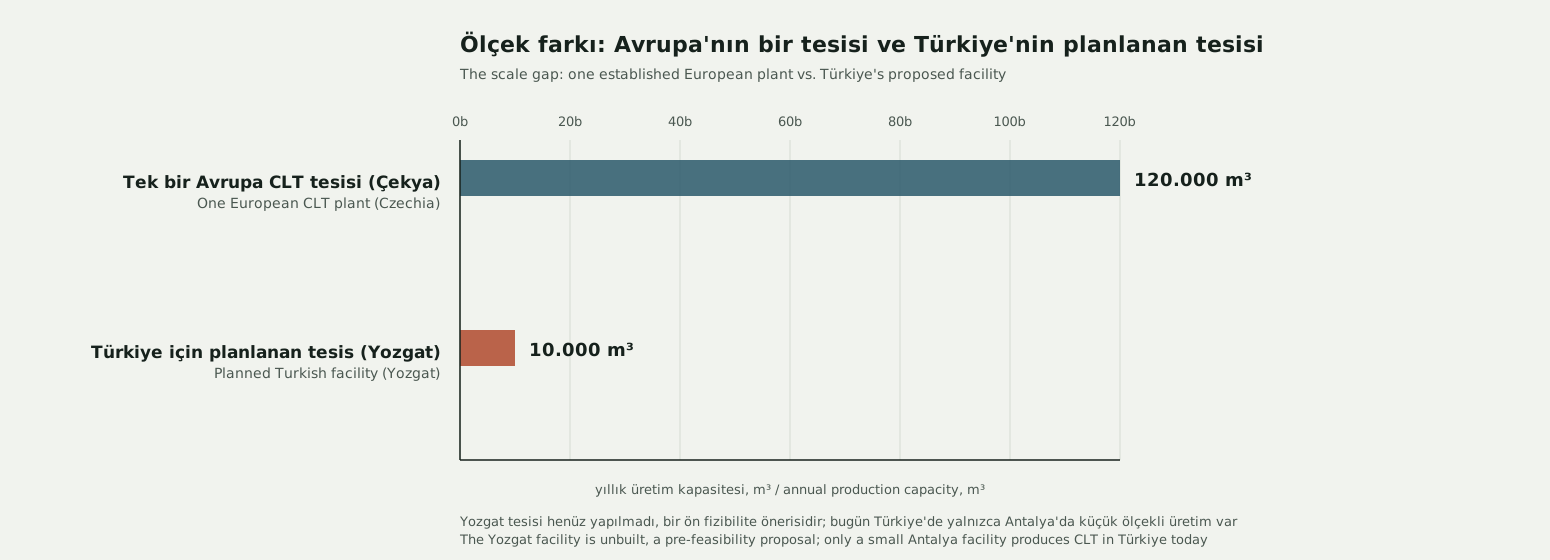
The Yozgat report itself makes the sharpest point: it notes, in its own words, that CLT remains under-adopted in Türkiye despite the country's seismic exposure — the same property that the SOFIE test data suggests should make cross-laminated construction more attractive here, not less. Whether that gap closes depends less on the wood, which Türkiye has, than on whether a domestic supply chain, trained installers and a track record of built projects appear to support it.
None of this is an argument against mass timber — including the reed- and straw-based engineered panels this publisher develops, which share exactly the same dependency on connection quality and moisture management described above, and the same need for a local supply chain to make the numbers work. It is an argument for treating "CLT" or "glulam" as a specific, standard-bound product with checkable manufacturing limits and a connection detail that carries the real structural risk, rather than as a green label applied to any glued wood assembly.
The most useful question to ask about any mass timber claim is not "is it CLT?" but "what strength class, tested to which standard, and detailed how at the connections?" — the first question has a marketing answer; the second has a checkable one.
Open knowledge — CC BY-SA 4.0. Copy it, correct it, cite it.
Related in the library
Share this