
Library · Standards · File 13
Net-zero energy buildings: what "zero" actually measures, and who actually checks
A net-zero claim can mean a metered annual balance or a design-stage model that was never checked again. The US and EU definitions, a database showing most declared projects are still unverified, and a Turkish public building that measured its own result instead of just modeling it.
Last reviewed — First publication; figures checked against the US DOE's 2015 'A Common Definition for Zero Energy Buildings,' the EU's 2024 recast Energy Performance of Buildings Directive (EU/2024/1275), the DOE's December 2025 rescission notice for its national Zero Emissions Building definition, New Buildings Institute's Getting to Zero Buildings Database (2020 report), the Bullitt Center's own published 10-year performance data, Wingfield, Bell, Miles-Shenton, South & Lowe's Stamford Brook field-trial report (Leeds Metropolitan University, 2008), Türkiye's 19 February 2022 amendment to the Binalarda Enerji Performansı Yönetmeliği, and Akgüç & Gali Taşçı's 2026 IMM Fatih Sports Centre nZEB case study (Gazi Üniversitesi Mühendislik Mimarlık Fakültesi Dergisi)
Soren H · Unsplash License
Verified vs. emerging zero-energy buildings (NBI, North America): ~20% verified / ~80% design-only · Bullitt Center 10-yr: 2,475,021 kWh generated vs. 1,923,540 kWh consumed (29% surplus) · Türkiye NSEB: Class B + 10% renewable (post-2025) · IMM Fatih Sports Centre: 231.3→103.1 kWh/m²/yr, 48% GHG cut
"Net zero" gets applied to almost anything from a single all-electric house to an entire developer's stated ambition, and the loose usage hides at least three separate questions that a specific claim needs to answer. What is being balanced — energy consumption, or emissions, and does embodied carbon from construction count alongside operational energy? How is the balance measured — a full year of metered, real-world data, or a design-stage energy model that was never checked again? And against what accounting method — site energy counted at the building's meter, or source energy that also counts everything lost upstream, at the power plant and along the grid? The US and the EU answer these questions differently from each other, and the US federal answer to one of them changed as recently as December 2025.
What the U.S. and EU definitions actually require#
The US Department of Energy's 2015 common definition is precise and quotable: "an energy-efficient building where, on a source energy basis, the actual annual delivered energy is less than or equal to the on-site renewable exported energy." Source energy, not site energy, is the deliberate choice — it accounts for extraction, processing, transport, generation and transmission losses upstream of the meter, using a national average conversion factor of 3.15 for electricity, so that a kilowatt-hour exported to the grid from a rooftop array offsets 3.15 times its own value in source-energy terms. The definition does not require a building to be off-grid — DOE describes a ZEB as "typically a grid-connected building" that uses the grid to export daytime surplus and import at night. A fair criticism, raised by RMI among others, is that a single nationwide conversion factor treats a building on a coal-heavy grid the same as one on a hydro-heavy grid, which blunts the incentive to actually decarbonize the specific grid a building sits on.
Table 1 — Four terms, four definitions#
| Term | What it balances | Set by | Status (2026) |
|---|---|---|---|
| Zero Energy Building | Source-energy balance: delivered energy ≤ exported on-site renewable energy | US DOE, 2015 | Active — still DOE's technical reference |
| nZEB | "Very low" energy need, largely covered by on-site/nearby renewables — no fixed numeric threshold | EU EPBD, in force since 2020 | Being phased out, replaced by ZEB |
| Zero-Emission Building (ZEB) | No on-site fossil-fuel emissions + very high energy performance | EU EPBD 2024 recast (2024/1275) | Mandatory for public buildings from 2028, all new buildings from 2030 |
| Zero Emissions Building | Voluntary federal criteria for efficiency, on-site emissions and clean sourcing | US DOE, June 2024 | Rescinded by DOE, December 2025 |
Claimed versus verified#
The New Buildings Institute maintains the Getting to Zero Buildings Database, the closest thing North America has to a public registry of zero-energy projects, and its own 2020 report draws a distinction that matters more than the headline growth numbers: a "verified" zero-energy building is one that has published 12 months of actual metered energy use and on-site renewable production data showing it hit the balance; an "emerging" zero-energy building is one that has stated the goal but has not — often because it is still under construction, or because nobody has gone back to check. Of the roughly 700 buildings on the list, only about 20% were verified; the remaining 80% were emerging. That is not a criticism of any individual project — many emerging buildings will verify in time — but it is a precise, sourced number for a fact the marketing language usually obscures: most public claims of zero-energy performance are still a stated intention, not a demonstrated result.
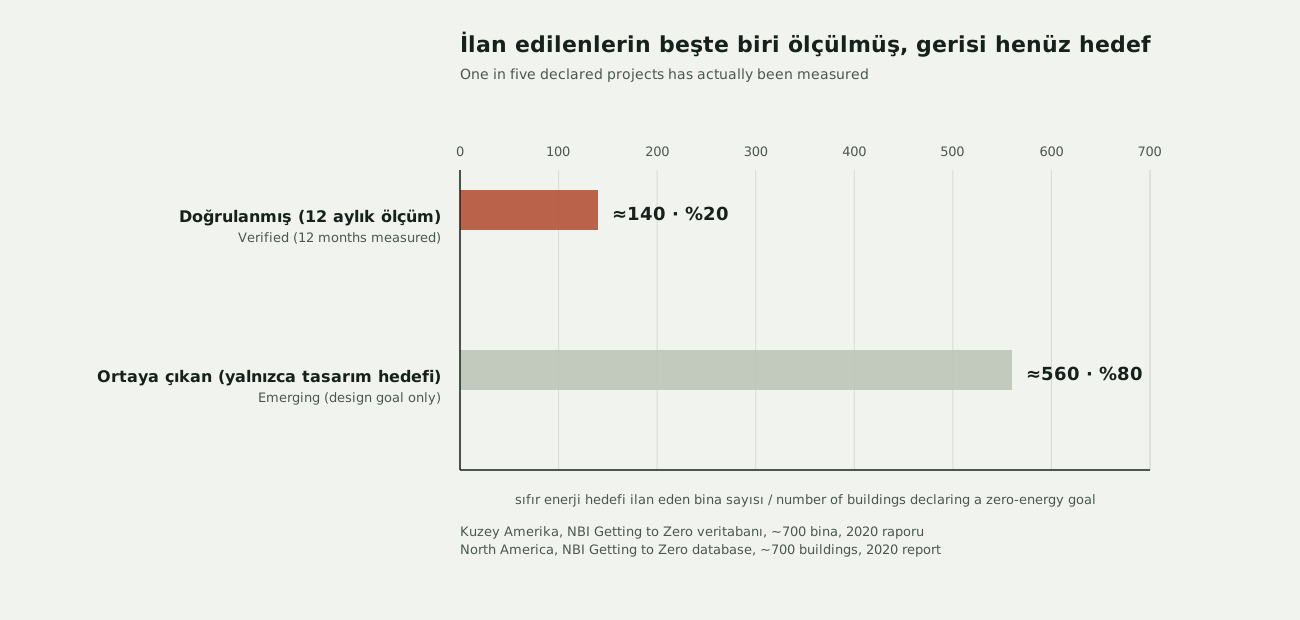
How to read it: a design model and a metered year are different kinds of evidence, not two versions of the same fact. A model tells you what a building should do if it is built, commissioned and occupied exactly as assumed; a metered year tells you what actually happened, including every assumption that turned out wrong. Both have a place — a model is the only evidence available before a building exists — but a public zero-energy claim that never converts from the first kind to the second should be read as a target, not a track record.
The performance gap: even measured buildings can miss their own numbers#
Verification is not the end of the story either, because measurement regularly finds that real buildings use more energy than their design predicted — a well-documented phenomenon called the performance gap. The Stamford Brook field trial, a detailed multi-year study of low-carbon UK housing by researchers at Leeds Metropolitan University, found that under standard occupancy, measured energy consumption and carbon emissions ran roughly 20–25% above design predictions, with the gap traced to a mix of thermal bypasses at party walls, heating-system inefficiencies and construction quality falling short of the modeled assumptions — not primarily to occupant behaviour, though other studies of the wider performance-gap literature find occupant variation is often the single largest factor. The lesson is not that measurement is pointless; it is closer to the opposite — the gap is only visible because someone measured. A building that only ever produced a design model would have reported the predicted number forever.
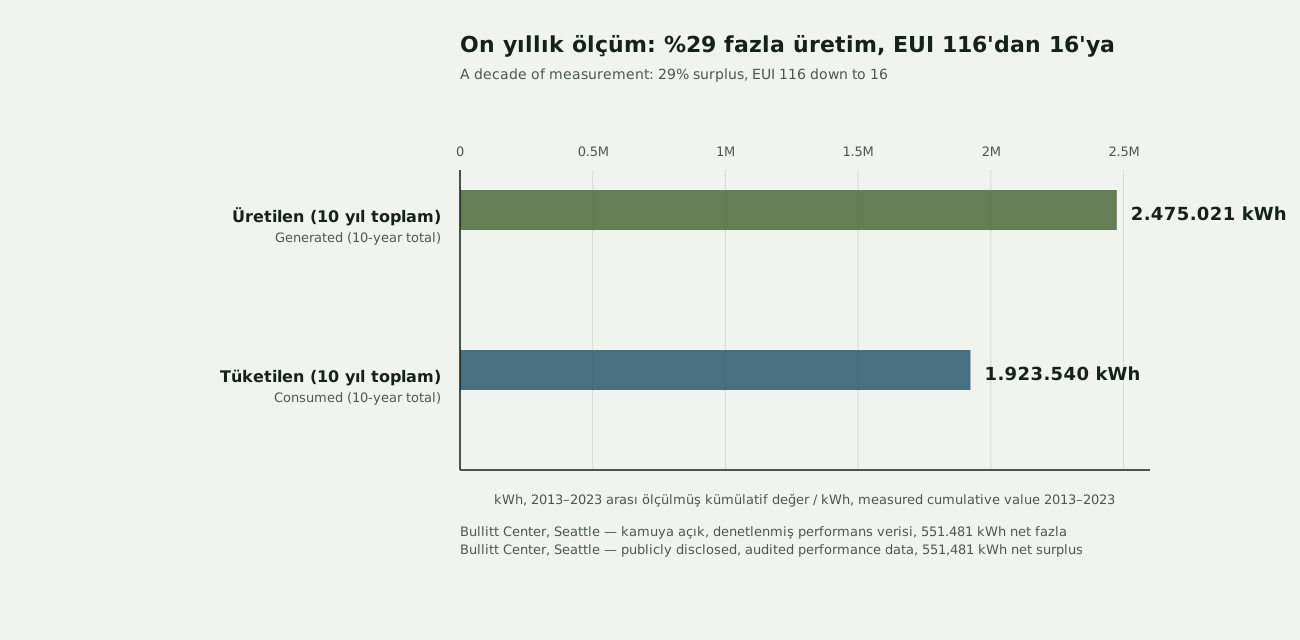
How to read it: a decade of published, third-party-auditable data is rare precisely because it is expensive and mildly risky to keep publishing — a bad year is visible too. The Bullitt Center's own reporting does not claim every single year individually cleared zero; it reports the cumulative ten-year balance, which is the more honest way to present a target that depends on annual weather, occupancy and grid conditions. That is the standard a genuinely verified zero-energy claim should be measured against, and it is a considerably higher bar than a single design model or even a single well-measured year.
Türkiye: a phased regulation, and the country's first measured public building#
Türkiye's own framework arrived through a 19 February 2022 amendment to the Binalarda Enerji Performansı Yönetmeliği (Energy Performance in Buildings Regulation), introducing the category Neredeyse Sıfır Enerjili Bina — NSEB, Türkiye's nearly-zero-energy-building term, aligned with the EU's earlier nZEB approach. The regulation phases in by building size and renewable share rather than applying uniformly overnight: from 1 January 2023 to 1 January 2025, new buildings of 5,000 m² or larger had to be built as NSEB, with at least 5% of primary energy demand met from renewable sources; from 1 January 2025 onward, the size threshold drops to 2,000 m² and the renewable share requirement doubles to 10%. Both phases share a fixed minimum: an Energy Identity Certificate (Enerji Kimlik Belgesi) of Class B or better — a real, checkable number on a real, mandatory document, not a marketing description.
What the regulation does not by itself provide is a measured example, which is what makes a 2026 case study of the İstanbul Büyükşehir Belediyesi's (IMM) Fatih Sports Centre worth citing in detail: it is presented by its authors as Türkiye's first comprehensive nZEB transformation of a public sports facility, and, unlike most retrofit case studies, it reports metered before-and-after numbers rather than a modeled projection alone. A three-phase retrofit — building-envelope upgrades to the TS825:2024 thermal standard, efficient lighting, and a rooftop array of 225 half-cut 550 Wp photovoltaic panels — moved the facility's Energy Identity Certificate from Class C to Class B and cut measured primary energy consumption from 231.3 to 103.1 kWh/m²·year, with the envelope work alone saving roughly 60 kWh/m²·year of natural gas. The PV array supplies about 11% of primary energy demand, clearing NSEB's 10% renewable threshold, and the combined measures delivered a 48% cut in greenhouse gas emissions — ahead of Türkiye's own national target of a 41% GHG reduction by 2030 (raised from an initial 21% at COP27) on the way to a declared 2053 net-zero goal.
- Most net-zero claims cover operational energy only: embodied carbon from materials and construction — the subject of this series' own File 06 and File 07 — is typically left out of the balance entirely, so a building can be a genuine, verified zero-energy performer in operation while its construction phase produced a large, unaccounted-for carbon debt.
- Most public project lists are self-reported design targets, not audited results: NBI's own database puts roughly 80% of North American "zero energy" projects in the unverified "emerging" category, so a project's presence on such a list is evidence of an intention, not by itself evidence of a result.
- The definitions themselves are not settled, even at the federal US level: DOE's voluntary Zero Emissions Building definition, issued in June 2024, was rescinded by the same department in December 2025 — a reminder that "zero" claims made against a specific named standard can lose their reference point without the building itself changing at all.
- A compliant design does not guarantee compliant operation: the Stamford Brook trial found well-monitored, well-intentioned UK homes running 20–25% above their own design predictions, which means even a properly modeled, permit-compliant NSEB building in Türkiye should be re-measured after occupancy rather than assumed to perform exactly as calculated.
Net-zero energy is not the same claim as off-grid, and the two are often conflated. A net-zero building is normally still grid-connected — it draws power at some hours and exports surplus at others, balancing to zero (or better) over a full year. Off-grid, covered in File 08 of this series, is a stricter and rarer condition: no grid connection at all, with every hour of demand met from on-site generation and storage. A building can be a rigorously verified zero-energy performer and still depend on the grid every single day.
None of this argues against the goal — the IMM Fatih Sports Centre shows a real, measured 48% emissions cut is achievable in a Turkish public building using exactly the retrofit playbook this series has already documented component by component: envelope performance to TS825, and rooftop solar built to the standards File 12 covered. The point is narrower: the publisher's own panel and PV-ready roof systems are not automatically a net-zero building any more than a certified BIPV module is automatically a certified roof — net zero is a whole-building annual energy balance, checked against a full year of real measurement, not a specification sheet for the components that go into it. Türkiye's NSEB path is itself a design-stage calculation; the IMM Fatih case is valuable precisely because it is one of the few Turkish examples that went back and measured the result instead of stopping at the model.
Open knowledge — CC BY-SA 4.0. Copy it, correct it, cite it.
Related in the library
Share this