Library · Standards · File 11
Hempcrete and mycelium: two "natural materials," two different stages of proof
Hempcrete has a RILEM test standard, a peer-reviewed carbon model, and — since 2024 — a place in the US model residential code with a hard seismic limit. Mycelium composites have genuinely good fire performance and no validated rating at all. What the numbers actually say, and why Türkiye's brand-new hemp regulation legalises the feedstock without yet building the construction pathway.
Last reviewed — First publication; figures checked against RILEM TC 236-BBM's hemp shiv characterisation recommendation, UK Hempcrete's published thermal-performance figures, Arehart, Nelson & Srubar's carbon-storage model (Journal of Cleaner Production 266:121846, 2020), the 2024 International Residential Code Appendix BL, Pennsylvania Housing Research Center's hempcrete report, a 2025 mycelium-composites architectural review (Sustainability 17(24):11350), and Türkiye's January 2026 hemp cultivation regulation (Official Gazette No. 33154)
Prometheus · Unsplash License
Thermal conductivity: hempcrete 0.06–0.07 W/mK vs mycelium 0.03–0.06 W/mK · Carbon storage per 1m² wall: −15.95 kg CO2e (best mix) to +8.16 kg CO2e (worst mix) · IRC Appendix BL seismic limit: Design Categories A–C only
Hempcrete and mycelium composites get grouped together constantly under "natural building materials," and the grouping obscures something important: they are not at the same stage of development. One has a standardised characterisation test, a peer-reviewed carbon-accounting model, and — as of 2024 — a place in the US model residential code with explicit structural limits. The other has genuinely impressive fire behaviour in lab testing and almost nothing else a code official could check against. Treating them as interchangeable "natural" alternatives skips past exactly the distinction that matters for anyone actually specifying one.
Hempcrete: infill, not structure#
Hempcrete is a mix of hemp hurd — the woody core of the stalk, left over after the long bast fibre is stripped for textiles — and a lime-based binder, cast or sprayed around a structural frame. It is, without qualification, a non-structural material: a research report from Pennsylvania State University's Housing Research Center states plainly that hempcrete "is typically utilized as a non-structural insulative infill for floor, roofs and walls" and requires "a structural backup wall or integral structural framing." Where load-bearing capacity is needed at all, it comes from reinforced-concrete columns or steel/FRP framing elements cast into the hempcrete, not from the hempcrete itself — after a year of curing, typical compressive strength runs only about 0.32–0.40 MPa, a small fraction of what a structural material needs.
What the test standard actually standardizes#
The closest thing hemp shiv has to an international standard is a RILEM technical committee recommendation (TC 236-BBM), and it is worth being precise about what it does and does not do. It specifies reproducible laboratory procedures — hot-plate or hot-wire methods for thermal conductivity, a defined mould-and-weighing procedure for dry density, standard tests for water absorption and particle-size distribution — so that results from different labs and different hemp varieties can be meaningfully compared. It does not set a single fixed thermal-conductivity or density value for hemp shiv, and it says so explicitly: the recommendation derives from a single "Round Robin Test" carried out on one hemp shiv variety, because hemp shiv properties vary significantly by origin, growing conditions, harvest timing and processing. In practice, published wall-mix values cluster around 0.06–0.07 W/mK for thermal conductivity, with dry density varying widely by application — lighter mixes for roof insulation, denser mixes where floor or subfloor load transfer matters.
Table 1 — Hempcrete and mycelium composites compared#
| Property | Hempcrete | Mycelium composite |
|---|---|---|
| Thermal conductivity | 0.06–0.07 W/mK | 0.03–0.06 W/mK |
| Density | ~275–450 kg/m³ | ~50–282 kg/m³ |
| Compressive strength | ~0.32–0.40 MPa | ~0.05–0.18 MPa |
| Structural role | Non-structural infill only | Non-load-bearing, largely temporary |
| Code / standard status | RILEM test method; 2024 IRC Appendix BL | No validated fire rating; no code path |
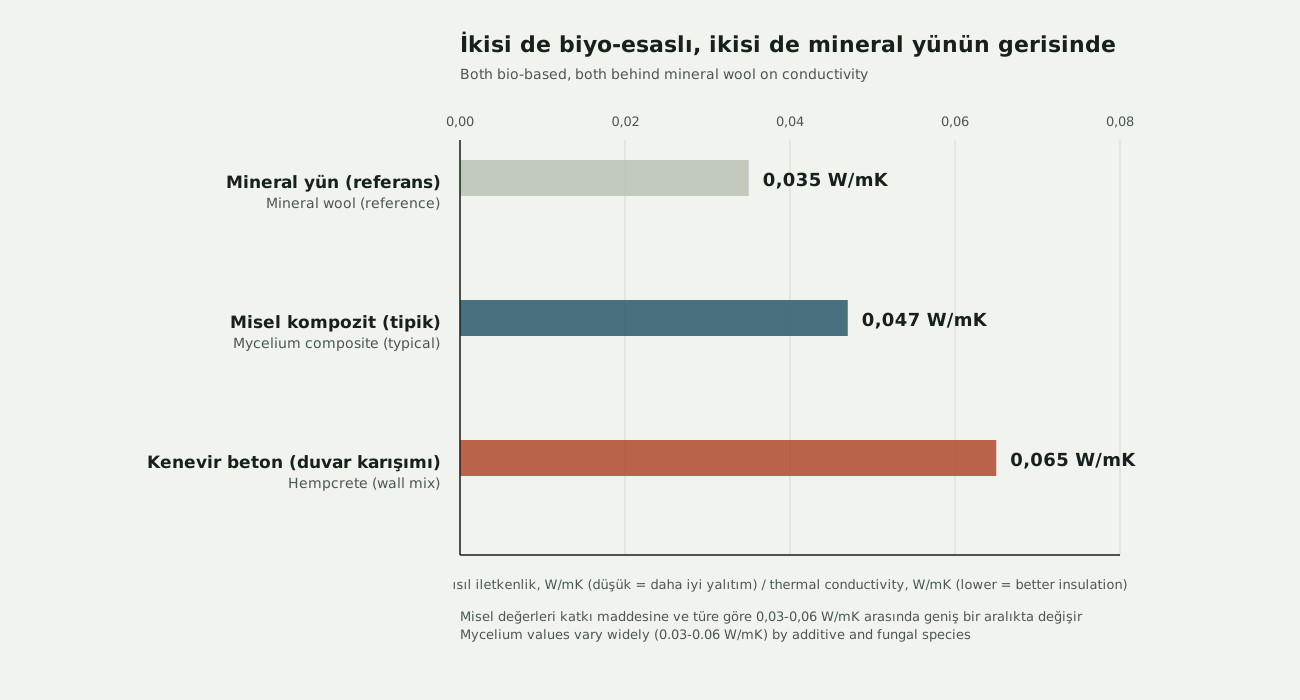
How to read it: mycelium's range is wide because fungal species and growth substrate change the result substantially — the 0.047 W/mK figure is a representative midpoint from a 2025 architecture-and-design review, not a fixed specification the way a mineral wool datasheet gives one.
The carbon claim, precisely: usually negative, not always#
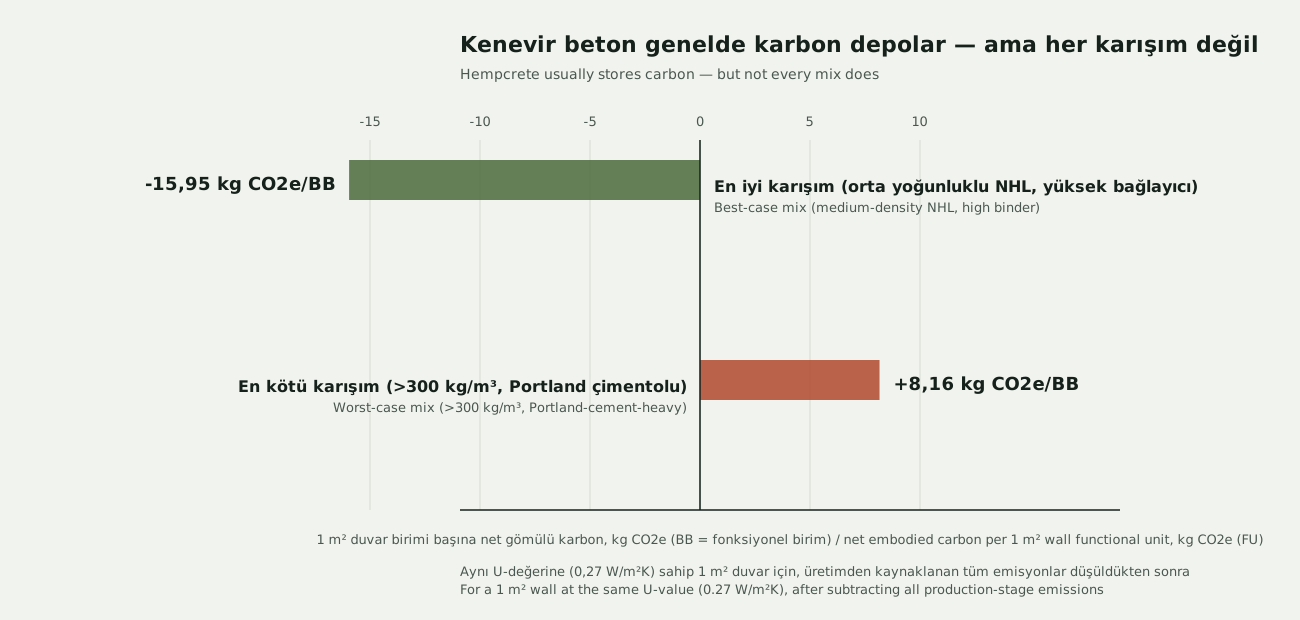
"Hempcrete is carbon-negative" is repeated often enough to sound unconditional, and the underlying research is more careful than that. A 2020 peer-reviewed model published in the Journal of Cleaner Production (Arehart, Nelson & Srubar) calculated net life-cycle emissions per functional unit — one square metre of wall at a fixed U-value of 0.27 W/m²K — across a range of realistic hempcrete mixes, accounting for hemp's biogenic carbon uptake during growth, lime binder's calcination emissions, and the CO2 the binder recaptures afterward through carbonation (the study found 18.5–38.4% of initial binder emissions get recovered this way). The best-performing mix — a medium-density natural hydraulic lime formulation with a high binder concentration — stored a net −15.95 kg CO2e per functional unit. But the same paper is explicit that this does not generalize: high-density mixes above roughly 300 kg/m³ that use Portland cement in the binder can turn net-positive, with one such formulation calculated at +8.16 kg CO2e per functional unit — an emitter, not a sink.
IRC Appendix BL: the first real code path, with a hard seismic limit#
In 2024, hemp-lime construction entered the International Residential Code — the model code most US jurisdictions adopt — as Appendix BL, the first time hempcrete has had a dedicated path through a mainstream building code rather than a case-by-case alternative-materials approval. The appendix is specific rather than aspirational: buildings are limited to one storey above grade and 25 feet (7.6 m) in height, maximum wall weight is capped at 65 psf (50 psf for block-veneer systems), minimum compressive strength is set at 29 psi to hold plaster, vapour retarders and water-resistive barriers are prohibited on hemp-lime walls (the assembly relies on vapour permeability, not a vapour block), and metal fasteners in contact with the hempcrete must be stainless or coated. The limit worth pausing on: Appendix BL restricts hemp-lime wall systems to Seismic Design Categories A, B and C — the code's own lower-to-moderate seismic tiers. It does not extend to Category D, E or F, the tiers that cover the most earthquake-prone regions.
Mycelium: real fire performance, still an experimental material#
Mycelium composites are grown, not manufactured: fungal mycelium is fed agricultural waste (straw, sawdust, hemp hurd itself is one common substrate) inside a mould, and the fungus binds the substrate into a solid block as it grows, which is then heat-treated to halt growth. A 2025 review of mycelium composites for architectural and design applications (Sustainability 17(24):11350) reports the properties in Table 1 above, and two findings stand out. First, the genuinely good news: mycelium composites show low heat release, minimal smoke production, a high char yield and, in some formulations, self-extinguishing behaviour — a real fire-performance advantage over synthetic foam insulation. Second, the honest limitation: the same review states plainly that "the absence of standardized performance data" and validated fire ratings prevents mycelium composites from obtaining building code approvals or material certifications under ASTM or ISO frameworks at all. In this publisher's own three-tier framework — established knowledge, emerging technology, experimental idea — mycelium composites sit squarely in the third category: a genuinely promising material with real lab-measured advantages that has not yet cleared the standardisation bar hempcrete cleared with RILEM and, now, IRC Appendix BL.
- Water absorption is a serious open problem: published figures show mycelium composites absorbing over 200% of their weight in water, causing mechanical weakening and dimensional instability — a material that is only usable where moisture exposure is tightly controlled.
- The same biology that gives mycelium its fire and insulation properties also makes it actively biodegradable in the wrong conditions: soil-burial tests recorded up to 50% mass loss within 16 weeks.
- Compressive strength varies enormously by fungal species and substrate — from roughly 0.03 MPa for some Pleurotus ostreatus composites up to a reported 1.91 MPa outlier for Ganoderma lucidum in specific substrates — meaning a result from one lab's mix says little about a different species-substrate combination.
- Hempcrete's own limitation is worth repeating alongside mycelium's: it cannot tolerate prolonged moisture exposure or below-grade contact either, needs a minimum 8-inch (200 mm) separation from grade and a capillary break at the foundation, and takes 2–8 weeks to dry before finishes can go on — a material with genuine moisture-management requirements, not a maintenance-free one.
"No validated fire rating" is not the same as "performs poorly in fire" — the lab-scale results for mycelium are genuinely encouraging. It means no test lab has yet produced the kind of standardized, repeatable ASTM E84/UL 723-class rating that a code official or an insurer can check a specific product against, the way they can for a listed mineral-wool batt. Until that exists, mycelium composites belong in non-structural, non-life-safety-critical applications — packaging, acoustic panels, temporary installations — rather than in a wall assembly a code inspector has to sign off on.
Türkiye: the feedstock is newly legal, the construction pathway is not yet built#
Türkiye replaced its hemp cultivation framework with a new regulation published 31 January 2026 (Official Gazette No. 33154), consolidating and expanding the licensing system the Ministry of Agriculture and Forestry first introduced in 2016. Fibre, seed and hurd production — the exact category hempcrete needs — is now authorized across 21 provinces, with a defined application window and a THC ceiling of 0.3% for licensed varieties, alongside separate licensing tracks for medical and personal-care cannabinoid products that stay explicitly out of recreational use. The practical upshot: hemp hurd, the raw material a hempcrete wall is built from, is a lawful, licensed agricultural product in Türkiye today. What the regulation does not do — and does not attempt to do, since it is an agricultural licensing framework, not a construction one — is connect that hurd to a building-code pathway. No Turkish equivalent of RILEM's characterisation-test recommendation or IRC Appendix BL's structural and moisture provisions currently exists.
There is a sharper point worth making explicitly, because it connects directly to a theme this series has returned to before (File 07, on the 2023 Kahramanmaraş earthquakes): even the most advanced hemp-lime building-code provision that exists anywhere — IRC Appendix BL — was written for, and limited to, Seismic Design Categories A, B and C. Türkiye's seismic hazard puts most of the country outside that envelope. Importing the US appendix wholesale would not responsibly cover the conditions a Turkish hemp-lime wall would actually face; a domestic code path would need seismic testing data for hemp-lime wall systems under Türkiye-representative ground motion, which does not appear to exist in the published literature yet. This is not a reason to dismiss hempcrete for Türkiye — it is a reason the next step here is testing, not adoption.
None of this is an argument against either material — including in this publisher's own systems, where a hemp-lime infill panel inside a SIP or timber frame is a plausible complement rather than a competitor, since both hempcrete and mycelium composites need exactly the kind of structural frame this publisher's panels already provide. The most useful question to ask about a "natural material" claim is not whether it sounds sustainable, but where it sits on the established-emerging-experimental scale: hempcrete has a characterisation-test standard and a code appendix with real seismic limits; mycelium has excellent lab results and no fire rating a building official can check. Both are honest, useful facts — they are just not the same fact.
Open knowledge — CC BY-SA 4.0. Copy it, correct it, cite it.
Related in the library
Share this