
Library · Standards · File 25
Modular commercial buildings: when "modular" has to carry a crowd, not a family
A modular hotel or hospital wing gets no discount on occupancy code. What actually changes for commercial modular — and a hotel project that was marketed as a record before a single module was ever placed.
Last reviewed — First publication; figures and claims checked against the International Building Code Section 3113 (Relocatable Buildings), ICC-ES AC543 (approved October 2022), ICC/MBI 1205-2021, Hwang & Kim's 2022 systematic review (Journal of Computational Design and Engineering 9(4)), McKinsey's 2019 modular-construction report, GlobeSt's 2019 reporting on citizenM Bowery, The Real Deal's 2024 reporting on the canceled AC Hotel NoMad, and Daily Sabah/Wikipedia-cross-checked reporting on Istanbul's 2020 COVID-19 field hospitals

Adesh Bankar · Unsplash License
citizenM Bowery: 19 stories, completed 2019 · AC Hotel NoMad: 26 stories planned, never built · Istanbul field hospitals: 1,008 beds each, 52-day build
Every other article in this series about modular construction — housing, off-grid cabins, post-disaster shelters — has been about buildings for a household or a family. Commercial modular construction is a different problem wearing the same word: a modular office floor, hotel tower or hospital wing has to hold dozens or hundreds of strangers at once, and life-safety codes do not offer a volume discount for being built in a factory. What changes when "modular" has to carry a crowd, not a family, is occupancy classification, egress and fire separation between stacked units, a structural-evaluation path most residential modular projects never touch — and, as two real hotel projects with opposite fates show, a genuine gap between what gets marketed and what gets built.
Same occupancy code, no discount for being modular#
The Modular Building Institute is blunt about this: "there is no modular building code." A modular hotel, office or clinic is designed to the exact same International Building Code occupancy classification as its site-built equivalent — Group B (business), Group M (mercantile), Group R-1 (transient hotel/motel), Group A (assembly) or Group I (institutional, for a hospital) — with the same means-of-egress, fire-separation and structural-load requirements either way. What is factory-built is the construction method, not the code path. This is the same finding File 04 reached about modular housing in general, restated here because commercial occupancies raise the stakes of getting it wrong: a hotel corridor or a hospital ward has far more people, far less familiarity with the building, and far less tolerance for an egress or fire-separation shortcut than a single-family home.
The one real carve-out — and how unevenly states apply it#
The IBC does contain one genuine exception aimed at commercial/institutional use: Section 3113, "Relocatable Buildings" — the code path most portable classroom blocks, temporary site offices and short-term clinic annexes use. It is narrower than it sounds: it applies to buildings intended to be reused at multiple sites, and it still requires the structure to meet applicable occupancy, structural and fire-safety provisions — it is a use-and-reuse pathway, not a lower safety bar. And even this one carve-out is not applied uniformly: Minnesota's building code deletes IBC Sections 3113.1 through 3113.4 in their entirety and substitutes its own state administrative rule (Minnesota Rules Chapter 1361) instead, one of roughly 35 US states that run their own modular/relocatable-building administrative programs rather than adopting the IBC section as written. A national model code exists; a nationally uniform relocatable-building rule does not.
Table 1 — Three commercial-modular code paths compared#
| Permanent modular (Group B/M/R-1/etc.) | Relocatable (IBC §3113) | Site-built equivalent | |
|---|---|---|---|
| Intended use | Fixed location, full service life | Reused across multiple sites | Fixed location, full service life |
| Occupancy code | Full IBC occupancy classification, no exception | Full IBC occupancy classification, still applies | Full IBC occupancy classification |
| Structural evaluation path | ICC-ES AC543 evaluation report typical | Same, plus reuse/re-installation review each move | Direct code review, no factory evaluation report |
| State-level uniformity | ~35 states run separate modular programs | Varies further — e.g. Minnesota replaces §3113 outright | Uniform IBC adoption (with local amendments) |
Structural performance on paper: ICC-ES AC543#
For a permanent commercial modular building, the document a code official actually checks is often an ICC-ES evaluation report issued against Acceptance Criteria AC543, "Structural Performance of Modular Components for Off-Site Construction" (approved October 2022, editorially revised April 2024). AC543 is not a design code — it is a testing-and-documentation protocol: a manufacturer's structural calculations for walls, floors, roofs and inter-module connections under gravity, wind, seismic and snow loads are reviewed, its material properties and quality-control process are checked, and its transport, handling and on-site connection procedures are evaluated, sometimes including physical prototype testing. The resulting evaluation report is what lets a code official rely on a factory's own engineering rather than re-deriving it project by project — the modular-specific piece of paper this series' companion standard, ICC/MBI 1200-2021, does not itself provide, since 1200 governs the planning/design/fabrication/assembly process rather than structural performance verification. A separate companion standard, ICC/MBI 1205-2021, governs the inspection and regulatory-approval procedures around that process — plans review, in-plant inspection and third-party certification — rather than the structural criteria itself.
What the economics literature actually finds#
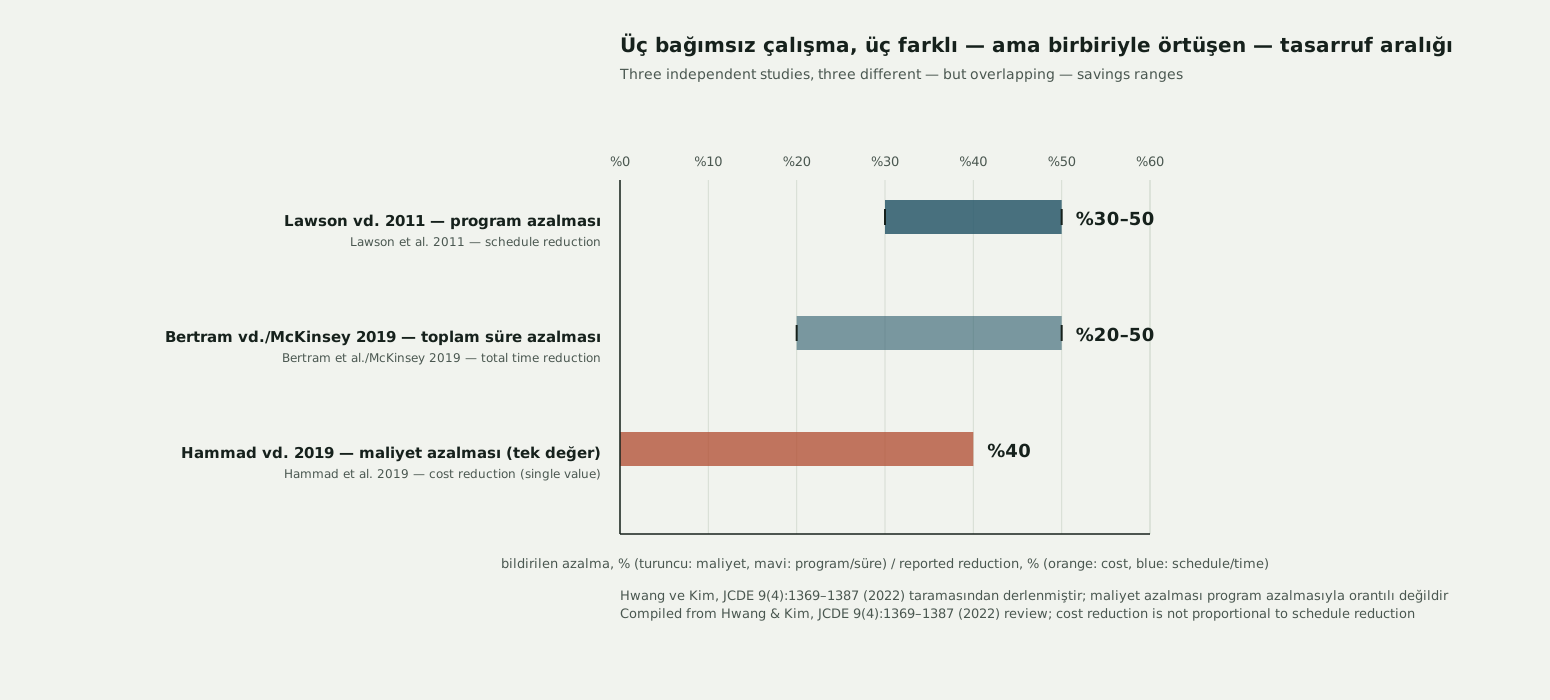
A 2022 systematic literature review (Hwang & Kim, Journal of Computational Design and Engineering 9(4):1369–1387) screened 220 Scopus-indexed papers down to 94 for detailed analysis and aggregated their findings on schedule and cost. The individual studies it reviewed report real but inconsistent ranges: Lawson et al. (2011) found construction periods cut by 30–50% with cost benefits up to 15%; Bertram et al.'s 2019 McKinsey analysis put volumetric modular's total-time reduction at 20–50%; Hammad et al. (2019) found a specific factory-framed wall/roof method cut cost by roughly 40% with markedly larger time savings. The review's own stated caveat is the honest part: "although modular construction allowed the reduction of the overall construction duration, cost reduction was not proportional to schedule reduction" — a faster build and a cheaper build are two different claims, not one. McKinsey's own report adds a second, commercially specific caveat: savings depend on high repeatability and real economies of scale (roughly 1,000+ comparable units a year), and it names high-end hotel and office buildings specifically as "examples of where significant savings are currently harder to achieve" — precisely the building type the next section's case study covers.
Two "record" hotels, two different fates#
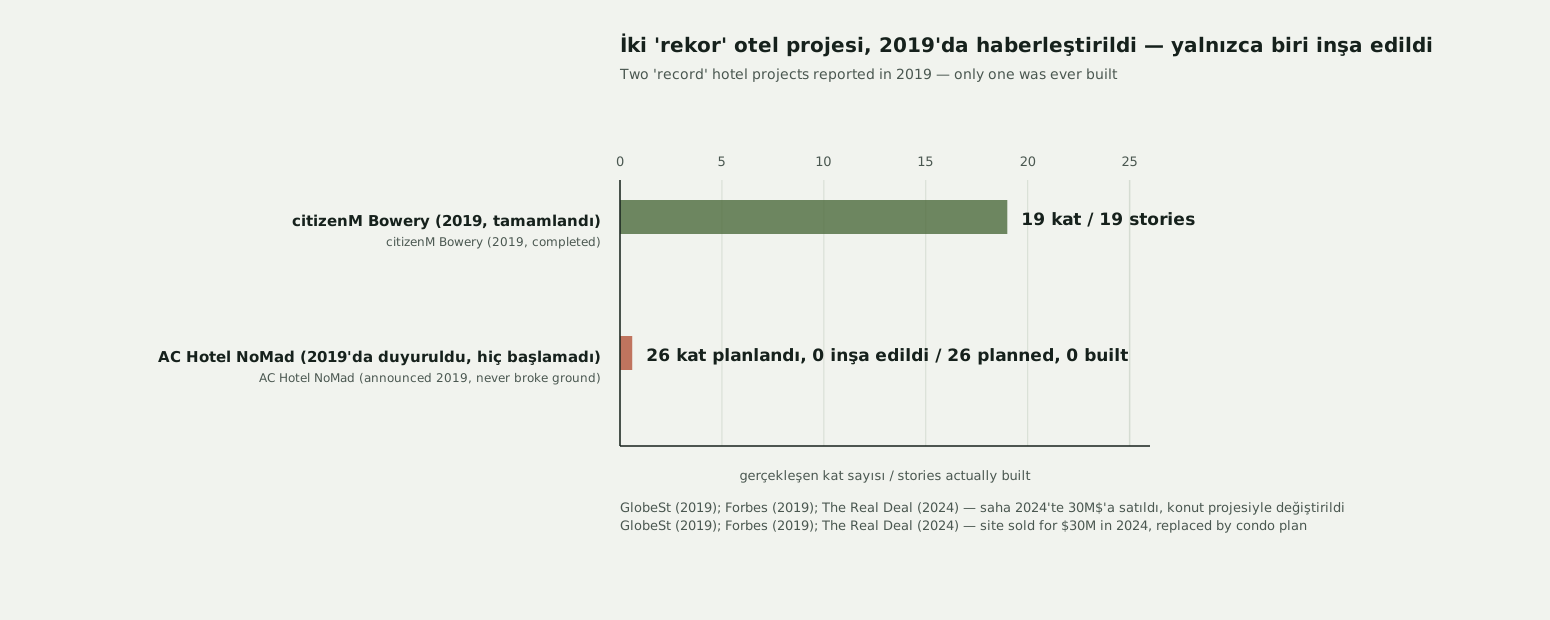
In June 2019, the trade press covered citizenM's 19-story, 246-foot modular hotel at 189 Bowery, Manhattan — 300 rooms across 100,000 sq ft, its modules manufactured by Poland's Polcom, shipped to Red Hook and stacked over roughly 24 weeks on top of three conventionally built base floors, at a reported cost of about $70 million. It was, at the time, described as the world's tallest completed modular-construction hotel — completed being the operative word. Five months later, Forbes covered a second, larger claim: a planned 26-story, 168-room AC Hotel by Marriott at 842 Sixth Avenue, marketed as the (future) world's tallest modular hotel, with modules manufactured in Poland and an architect describing a construction pace of "an entire floor a day." Plans were filed in 2017. As of a September 2024 report, the site had sat empty for years, work "never got off the ground," the lender had filed foreclosure over a $33 million default, and the developer sold the site for $30 million to a buyer who plans a residential condo instead — with one modular-industry veteran, Richard Born, on record saying he "would not do a 25-story modular building." One project delivered a real, occupied building; the other delivered a headline. Both were reported, at different points, as record-setting — only one number in that pair is checkable against a finished building today.
Türkiye's real commercial-scale precedent — and the standards gap around it#
Türkiye's most genuine large-scale commercial/institutional modular precedent is not an office tower — it is the pandemic-era field hospital programme. Ground was broken for the Yeşilköy field hospital, on Istanbul Atatürk Airport grounds, on 9 April 2020; it opened 31 May 2020, a 52-day build (the government's own public target, cited by President Erdoğan at groundbreaking, was 45 days — a small but real gap between the announced and the achieved timeline). Its statistics, cross-confirmed across CNN Türk, Habertürk, Daily Sabah and Anadolu Agency reporting at the time: 1,008 beds, 576 single patient rooms, 432 intensive-care-convertible beds (36 with dialysis), 16 operating theaters, across roughly 75,000 m² of covered building area on a 125,000 m² site, using a demountable, bolted prefabricated steel system. A near-identical second facility, the Sancaktepe field hospital on the Asian side, was built in parallel, and Daily Sabah reported the pair's combined target at roughly 2,000 beds. This is real, large-scale, rapidly delivered commercial/institutional modular construction, independently confirmed rather than taken from a single manufacturer's own account.
What Türkiye does not yet have is a dedicated commercial-modular building standard equivalent to IBC Section 3113 or a structural-evaluation criteria equivalent to ICC-ES AC543. TS EN 13369 ("General Rules for Prefabricated Concrete Products") governs prefabricated concrete elements as a materials standard, and related standards (TS EN 13225, TS EN 14992) cover specific concrete component types — but none of these is an occupancy-classification or modular-specific structural-evaluation code for commercial buildings the way the US framework above is. The field hospitals were delivered through direct government procurement and manufacturer engineering under general Turkish building-code compliance, not through a named modular-commercial code pathway — a genuine capability without yet a dedicated standard behind it.
- Transport economics still apply: a large, mostly-empty three-dimensional module is expensive to move past a certain distance, which is why commercial modular projects cluster near factories — the same limit File 04 found for residential modular.
- Reported savings assume real economies of scale (roughly 1,000+ comparable units/year per McKinsey) — a one-off commercial modular project does not automatically get the aggregate percentages cited in the literature.
- Even the one code carve-out aimed at commercial/institutional relocatable use (IBC §3113) is applied unevenly state by state — a national model section is not the same as a national rule.
- A marketed record and a built record are different claims: the AC Hotel NoMad shows a modular project can be extensively reported before a single module is ever craned into place, and can still be canceled years later.
None of this argues against modular construction for commercial buildings — the Istanbul field hospitals show what factory-built delivery can genuinely achieve at speed and scale when the economics and logistics line up. It argues for treating a commercial modular claim exactly the way this series has treated every other one: check the occupancy classification, check which code path (permanent or relocatable) the project actually follows, check whether a structural-evaluation report like AC543 exists, and — before citing any project as a record — check whether it was ever actually built.
Open knowledge — CC BY-SA 4.0. Copy it, correct it, cite it.
Related in the library
Share this