
Library · Standards · File 24
Post-disaster modular shelters: one word, three timeframes, and what happens when "temporary" doesn't end
"Post-disaster shelter" covers emergency, transitional and durable housing — three timeframes governed mostly by a voluntary minimum-standards handbook rather than any binding structural code. An award-winning modular design saw two-thirds of its purchased fleet mothballed after real fire-safety concerns, and Türkiye's own post-2023 earthquake data shows what "transitional" tends to mean in practice: a multi-year reality for a shrinking but still substantial population.
Last reviewed — First publication; figures and claims checked against the Sphere Handbook (4th ed., 2018), UNHCR's Emergency Shelter Solutions and Standards guidance, IFRC's Post-disaster Shelter: Ten Designs (2013), Pym & Hooper's 2017 Humanitarian Exchange study of Sphere adherence in Haiti, Better Shelter's own fire-safety resource, Dezeen's 2017 reporting on the Better Shelter mothballing, TOKİ's December 2025 reconstruction statistics, and Turkish Minute/Gazete Oksijen reporting on Türkiye's container-city population
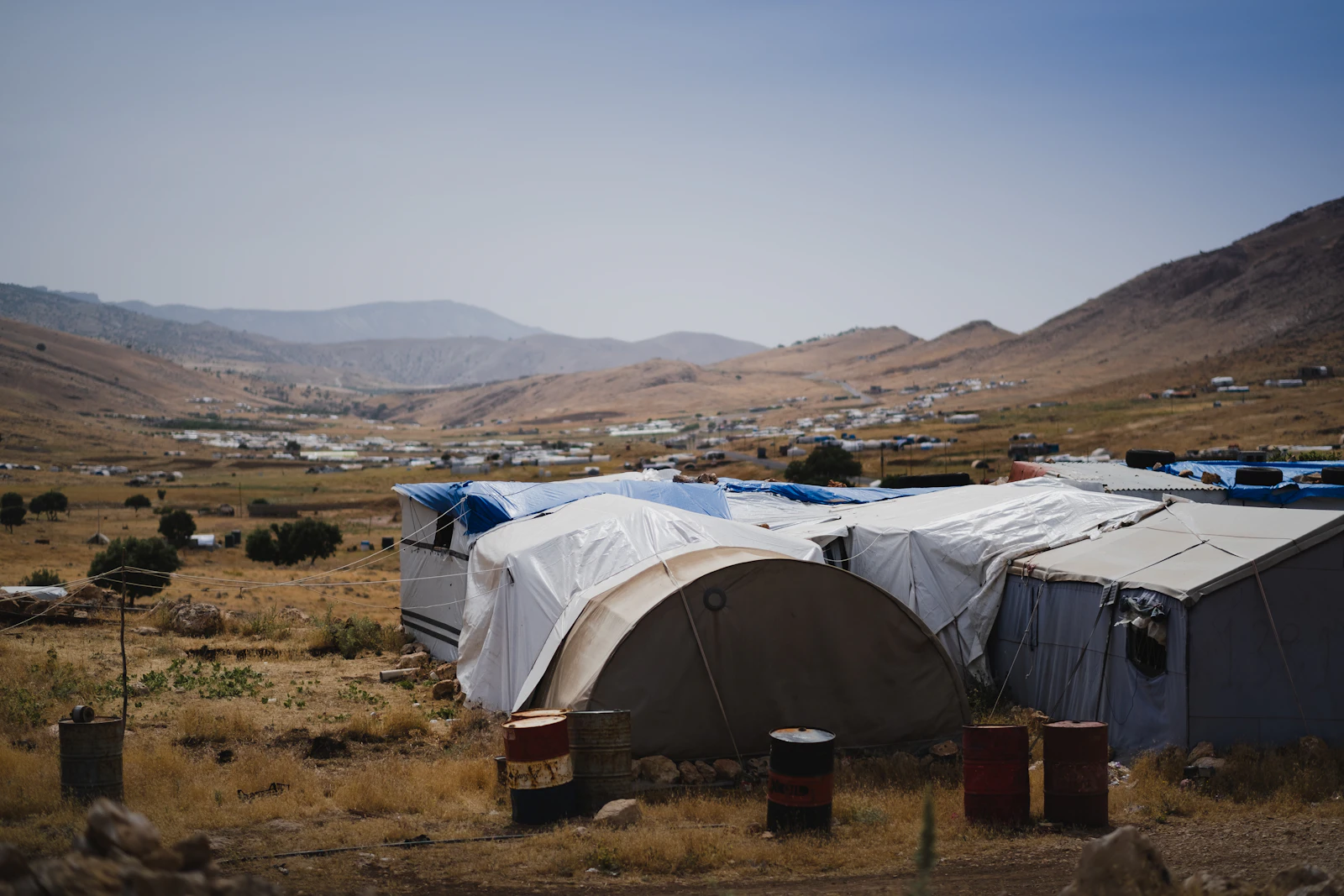
Levi Meir Clancy · Unsplash License
Sphere minimum: 3.5m²/person (warm) · 4.5-5.5m²/person (cold) · 45m²/30m² usable site area · Better Shelter: 15,000 purchased, 5,000 deployed, ~10,000 mothballed (~$12.5M) · Türkiye container population: 649,632 (Feb 2025) → 150,000+ (Feb 2026) · 455,357 permanent units completed (Dec 2025)
At the end of 2025, 117.8 million people worldwide were forcibly displaced — by conflict, persecution or disaster — according to UNHCR. "Post-disaster shelter" is the phrase used to cover what happens to a meaningful share of them, but the phrase hides three genuinely different timeframes, three different design logics, and, tellingly, only one of them has a real numeric standard behind it. The other two are governed mostly by improvisation, national procurement specifications, and — as both a much-publicized design failure and Türkiye's own three-year timeline show — a real gap between what gets marketed as "temporary" and what actually happens on the ground.
Three categories, not one, hiding under one phrase#
Humanitarian practice distinguishes emergency shelter (days to a few weeks — tents, tarpaulins, existing-building refuge), transitional shelter (the IFRC's own term, materials "that can be upgraded or re-used in more permanent structures, or that can be relocated from temporary sites to permanent locations" — typically months to a few years), and durable or permanent housing (full local building-code compliance, no design-life ceiling). The IFRC's own guidance is explicit that this is a spectrum, not a checklist: "shelter is a process, not a product." That framing matters because only the emergency and transitional categories have anything resembling a shared international reference point — durable housing simply falls back to whatever the national building code already requires (Türkiye's TBDY 2018 seismic code, discussed elsewhere in this series, among them).
Table 1 — Three categories, one governing reference point#
| Emergency shelter | Transitional shelter | Durable / permanent housing | |
|---|---|---|---|
| Typical duration | Days to weeks | Months to a few years | No design-life ceiling |
| Governing reference | Sphere Handbook minimum standards | Sphere + IFRC transitional-shelter guidance | National building code |
| Legal status | Voluntary, rights-based | Voluntary, rights-based | Legally binding |
| Example | Tent, tarpaulin | Better Shelter/RHU, container units | TOKİ housing, TBDY-compliant builds |
The only real numeric bar: Sphere's per-person minimums#
The Sphere Handbook (4th edition, 2018) — a voluntary, rights-based minimum-standards document, not a structural design code — sets the closest thing this field has to a universal number: minimum 3.5m² of covered living space per person in warm climates, rising to 4.5–5.5m² in cold climates where more of daily life happens indoors; a minimum 2m ceiling height; and a minimum 45m² of usable site area per person (reducible to 30m² where communal services are provided elsewhere), alongside site-planning rules — maximum 5% ground gradient, the site's lowest point at least 3m above the water table, minimum 2m spacing between structures plus a 30m firebreak for every 300m of built development. None of this is enforceable in the way a building code is: it is guidance a humanitarian response is expected to work toward, not a permit requirement a structure must pass before occupation. A 2017 Humanitarian Exchange study of the Haiti response (Pym & Hooper) found Sphere adherence "difficult or impossible" in the dense urban reality of post-earthquake Port-au-Prince, with responding organizations resorting to reinterpreting the standard's underlying family-size assumption from five people to four simply to make the area numbers fit the available urban plots — a genuine illustration of a rights-based minimum meeting a hard physical constraint, not evidence the standard itself is wrong.
When "marketed" and "measured" diverge: the Better Shelter case#
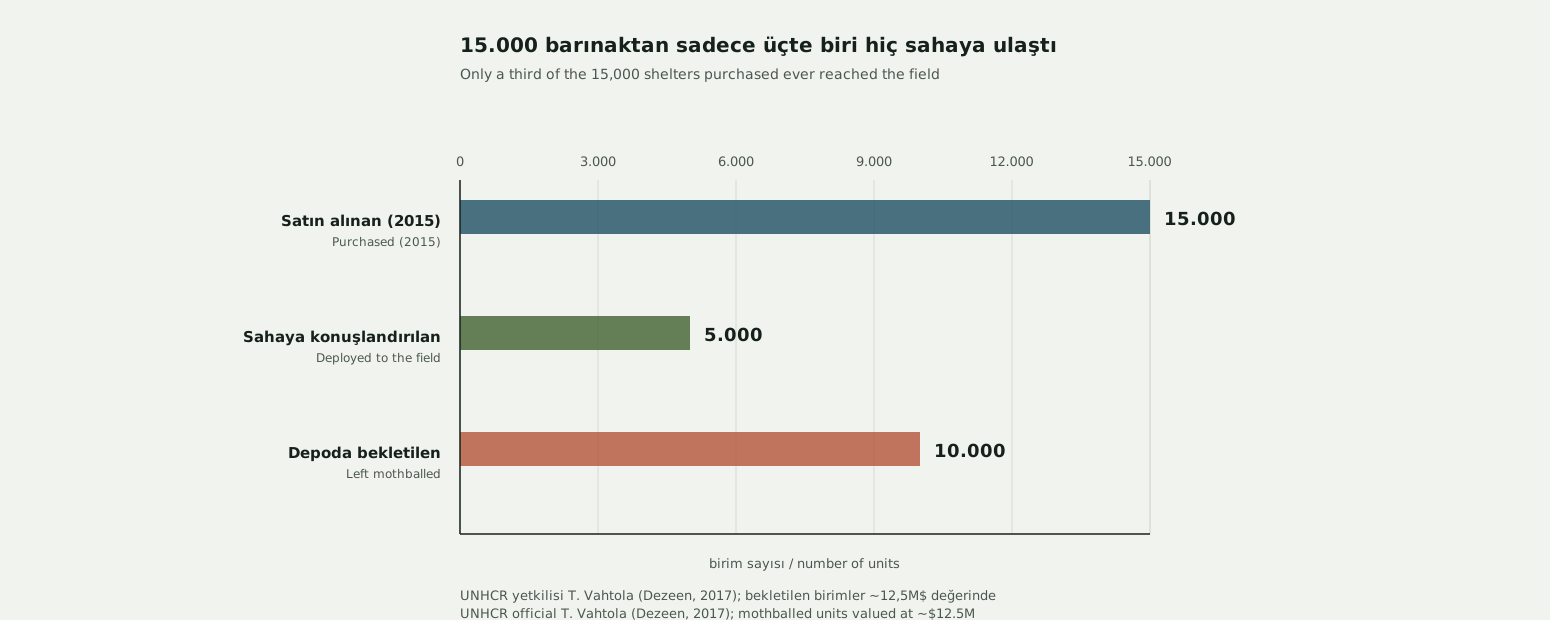
The IKEA Foundation/UNHCR Better Shelter unit — a 17.5m², polypropylene-panel, flat-pack Refugee Housing Unit assembled in about four hours without tools — is one of the most publicly celebrated pieces of humanitarian design of the last decade, winning the Design Museum's Beazley Design of the Year in 2016. It is also a genuine, well-documented example of the gap between marketed performance and field-measured performance. UNHCR purchased roughly 15,000 units in 2015; by 2017 only about 5,000 had actually been deployed (3,500 in Iraq, 400 in Djibouti, 100 in Niger, the rest split across Serbia, North Macedonia and Greece), leaving roughly 10,000 units — worth an estimated $12.5 million — sitting mothballed in storage. The reason: in late 2015, Swiss and German authorities raised fire-safety concerns about the panel material, and the city of Zürich formally rejected 62 units on those grounds. UNHCR's own account describes a deliberate pause: "following the identification of certain quality issues and based on experience gained and lessons learned in the field, deployment of shelters was put on hold" while the panel design, ventilation, frame strength and inter-unit spacing were reworked — current Better Shelter fire-safety guidance now specifies a 5m safe distance between units and a roughly two-and-a-half-minute safe-escape time, figures that did not exist in the same explicit form at the product's 2015 launch. None of this means the shelter model is unsafe today — the redesign process is exactly what should happen when a field-deployed product surfaces a real risk. What it demonstrates is that an award citation and a marketing description are not the same thing as a verified, field-tested safety record, and that the gap between the two can sideline two-thirds of a purchased fleet for years.
How long does "transitional" actually last? Türkiye's own data#
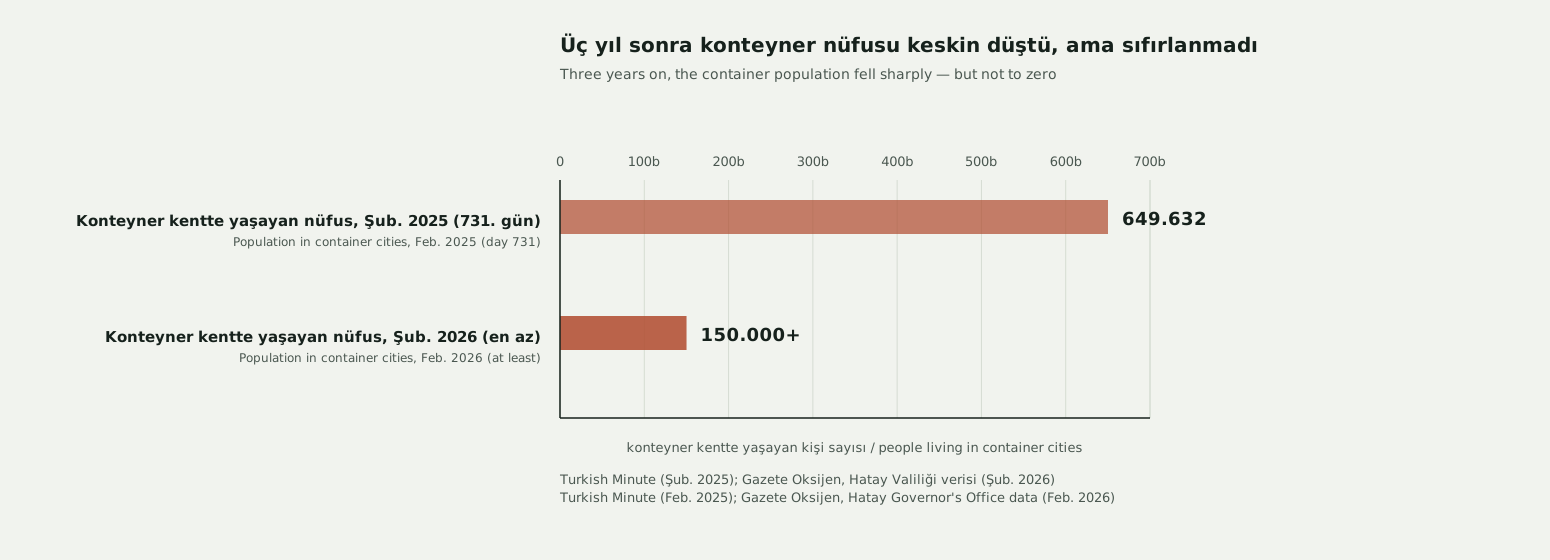
Türkiye's response to the February 2023 earthquakes is, by international comparison, a fast one: AFAD's container-city program housed millions within weeks, and TOKİ reports 455,357 completed permanent housing units across the earthquake zone as of late December 2025 — 367,995 residential units, 65,672 village houses and 21,690 commercial spaces, spread across 15 provinces, with the first foundation laid on day 15 and the first deliveries on day 45. That is a genuinely large logistics achievement in under three years. It sits alongside a second, less-publicized number: as of February 2025 (day 731), 649,632 people were still living in container cities — Hatay alone accounting for 218,379 of them — against a government target of 650,000 permanent units by that point, of which only 201,431 (63%) had actually been delivered. A year on, the residual population has fallen sharply but not to zero: Hatay's governor's office put it at roughly 148,000 people in official container cities as of September 2025, with local reporting estimating at least 150,000–180,000 people — at minimum 10% of Hatay's 1.56 million residents — still in containers as the third anniversary of the earthquake approached in February 2026. Set against IFRC's own transitional-shelter framing (materials meant to be upgraded, reused or relocated into permanent structures, on a stated lifespan of roughly 3–5 to 5–10 years depending on design) and against a real, cited container-unit example of 21m² housing a family, this isn't evidence the Türkiye program is failing — permanent-housing delivery at this scale and pace is a genuine achievement — but it is an honest illustration of what "transitional" tends to mean in practice for the population still waiting: months to a few years on paper, and a multi-year lived reality for a shrinking but still substantial number of people, a pattern documented in protracted-displacement settings well beyond Türkiye. A further, genuine 2025 finding worth naming: wildfires near Hatay in July 2025 forced the precautionary evacuation of roughly 6,500 people from areas including container settlements, a reminder that dense, long-duration temporary housing carries its own accumulating risk exposure the longer it persists.
IFRC's own definition of transitional shelter centers on materials that can be upgraded into or relocated as part of permanent structures. Steel shipping-container units, as widely deployed in Türkiye's response, are a genuine, fast, weatherproof interim solution, but they are not generally designed to be structurally absorbed into a permanent building the way IFRC's original transitional-shelter concept describes — they are typically resold or removed once no longer needed. Worth naming honestly rather than assuming the container response and the IFRC transitional-shelter ideal are the same thing.
- Sphere's per-person area minimums are voluntary humanitarian guidance, not an enforceable building code — actual site-level compliance varies enormously by response and cannot be verified at the scale a single article can check.
- The Better Shelter fire-safety pause was caught, disclosed and fixed — it is evidence of a working feedback loop between field deployment and design revision, not proof the modular-shelter model is inherently unsafe.
- Türkiye's 455,357-unit permanent-housing delivery in under three years is fast by international post-disaster comparison; the still-large residual container population reflects the genuine scale of displacement (14 million people across 108,000km²), not simple non-delivery.
- National aggregate figures cannot describe conditions at any one of Türkiye's 160-plus individual container-city sites — the numbers here are a national trend line, not a site-by-site verification.
None of this argues against modular or container-based disaster response — the alternative, in the days and weeks after a major earthquake, is not a faster permanent-housing program but no shelter at all. What the numbers argue for is precision about which of the three categories a given structure actually belongs to, an honest accounting of how a well-intentioned design can still surface a real safety gap after deployment, and a plain acknowledgment that "temporary" is a design intention, not a guarantee about how long people will actually live somewhere while the far slower work of permanent reconstruction catches up.
Open knowledge — CC BY-SA 4.0. Copy it, correct it, cite it.
Related in the library
Share this