Library · Standards · File 08
Off-grid modular housing: three engineering problems hiding behind one marketing word
Going off-grid doesn't remove code requirements — it adds two more on top of the structural one. What NEC 690/706 and NSF/ANSI 41/350 actually require, how battery autonomy-day sizing works, and why "off-grid" in Türkiye is almost always a choice rather than a necessity.
Last reviewed — First publication; figures checked against NFPA 70 (NEC) Articles 690 and 706, NSF/ANSI 41 and 350, published lead-acid/LiFePO4 cycle-life data, World Bank electricity-access data (2023), and Turkish Electricity Market Law No. 6446 and Forestry Law No. 6831
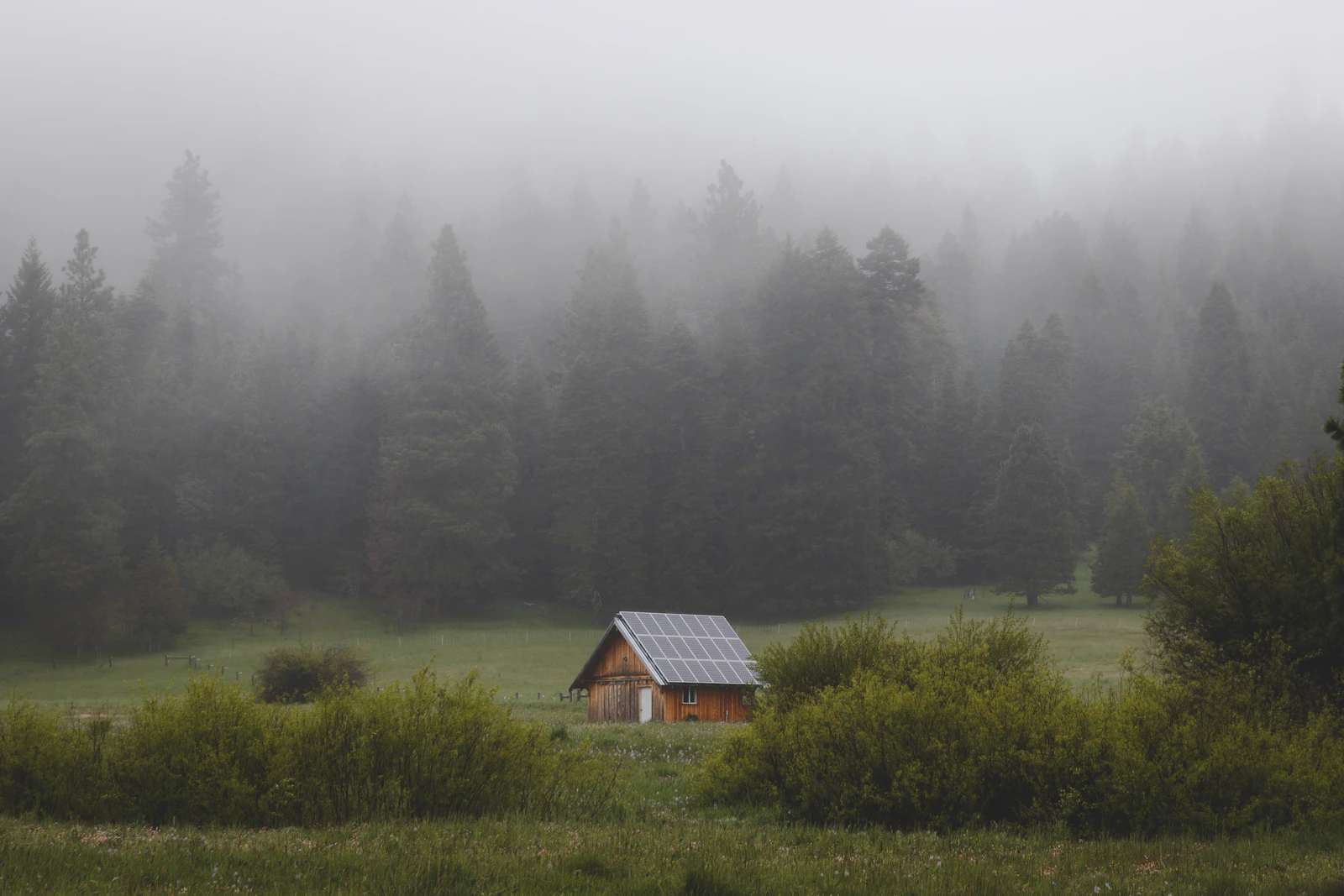
Alex Bierwagen · Unsplash License
Battery cycle life: lead-acid 300-500 cycles at 50% DoD vs LiFePO4 3,000-6,000 cycles at 80% DoD · Türkiye electricity access: 100% (2023) vs global average 92%
"Off-grid" sounds like subtraction — take away the utility connections and what's left is simpler. It is the opposite. A grid-tied modular home outsources three hard engineering problems to someone else's infrastructure: power quality, water treatment and waste disposal. An off-grid modular home has to solve all three itself, on-site, for every day of the year including the worst one. Going off-grid does not exempt a building from code — it adds two more code domains on top of the structural one.
Three systems, three different codes#
Power, water and waste each answer to a separate standard, and none of them is optional just because there is no meter, no main and no sewer connection to inspect. The structural and building code covered in File 04 of this series still applies unchanged — a modular shell does not become exempt from it by being self-sufficient.
Table 1 — Three subsystems, three codes#
| Subsystem | Governing standard | What it actually checks |
|---|---|---|
| Power | NEC Article 690 / 706 (or local equivalent) | Grounding, disconnects, arc-fault protection, listed inverters, labeling |
| Waste | NSF/ANSI 41 (composting) / 350 (greywater reuse) | Odor control, bacterial content limits, rated capacity, field verification |
| Structure | National/local building code (see File 04) | Unchanged by disconnecting from utilities |
How to read it: the middle column is not a suggestion — a composting toilet or a rooftop PV array that isn't built to the standard in this table is not "off-grid," it's just unregulated.
Sizing the power system: the autonomy-day problem#
The core sizing decision in any off-grid power system is "days of autonomy" — how many consecutive days with no useful sun the battery bank has to carry the load on its own. This is not a safety margin sitting idle; it is an active design input, and the right number varies by use case: 2–3 days is typical for a weekend cabin, 5–7 for a permanently occupied home, less for a facility with a backup generator. The governing formula is straightforward — battery capacity in amp-hours equals daily load times autonomy days, divided by system voltage, depth of discharge and round-trip efficiency — but every one of those inputs is a judgment call, and getting the daily-load estimate wrong is the single most common design failure in off-grid systems.
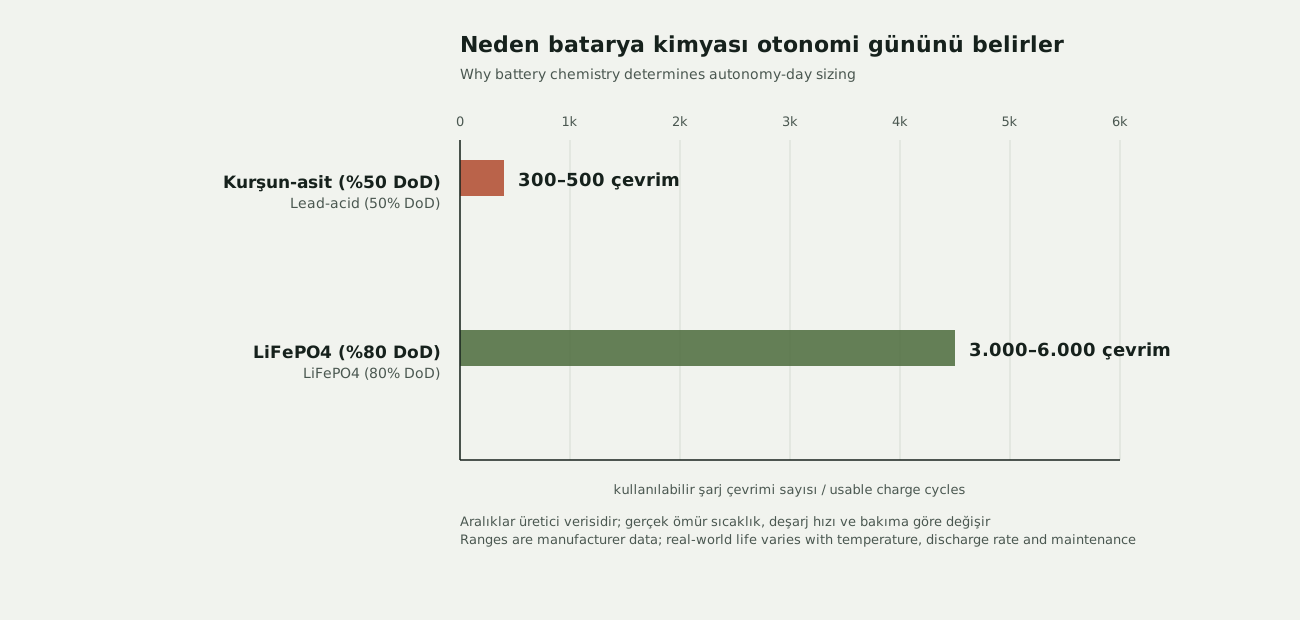
How to read it: these are manufacturer-published ranges under controlled conditions — real-world cycle life falls with cold temperatures, deep or fast discharge, and poor maintenance, so a design should treat the low end of the range as the planning number, not the high end.
Water and waste without a connection#
A composting toilet is not simply "a toilet that doesn't flush" — NSF/ANSI 41 certifies it against six specific, testable criteria: rated capacity over an extended period plus occasional overload, no offensive odor, verified bacterial content in the finished compost, non-misleading marketing claims, blind testing so manufacturers cannot influence results, and field verification of the lab results in real operating conditions. A greywater reuse system built to NSF/ANSI 350 goes through an equivalent process for treated wastewater quality. Both standards exist because "handles the load and doesn't smell" is exactly the kind of claim that is easy to make and hard to verify without one.

"Off-grid" does not mean "unregulated." A composting toilet or greywater system typically still needs local health-department or building-department approval even where no sewer connection exists to inspect — the absence of a pipe does not remove the permitting requirement.
Türkiye: off-grid is a lifestyle choice, not a necessity — and the paperwork reflects that#
World Bank data puts Türkiye's electricity access rate at 100% as of 2023 — against a global average of about 92%, with an estimated 666 million people worldwide still lacking access entirely. That context matters: in much of the world, an off-grid design is a response to genuine infrastructure absence. In Türkiye today, it is almost always a deliberate choice made on land the grid could already reach.

The legal framework reflects that gap between choice and necessity. A building permit (yapı ruhsatı) is required regardless of grid connection — there is no off-grid exemption from the building code. Self-generated electricity is legal under the Electricity Market Law (No. 6446), and unlicensed generation for a grid-connected consumption facility is capped at that facility's own contract power rather than a fixed kilowatt figure — though that provision is built around net-metered, grid-tied systems and is largely beside the point for a genuinely disconnected one. The sharper restriction is land use: construction on forest land is absolutely prohibited under the Forestry Law (No. 6831), with penalties that include demolition and imprisonment — a serious constraint given how much of Türkiye's off-grid-cabin aspiration gravitates toward exactly that kind of forested or highland setting.
None of this is an argument against off-grid design, including the modular systems this publisher develops. It is an argument against treating "off-grid" as a single marketing claim rather than three separate, checkable engineering problems — a factory-built shell with a rooftop solar decal is not an off-grid home; it is a building with a gap where three certified subsystems used to be.
The most useful question to ask about any claim of being "off-grid" is not "does it have solar panels?" but "what autonomy days is the battery sized for, what standard certifies the waste system, and what does the actual land classification permit?" — the first question has a marketing answer; the second has three checkable ones.
Open knowledge — CC BY-SA 4.0. Copy it, correct it, cite it.
Related in the library
Share this