
Library · Standards · File 10
Recycled steel: what "100% recyclable" doesn't tell you
Steel's recyclability and its recycled content are two different, non-interchangeable claims. What the three production routes actually cost in carbon, why copper sets a hard ceiling on how much scrap high-grade steel can absorb, and why Türkiye's unusually EAF-heavy industry depends partly on being the world's largest scrap importer.
Last reviewed — First publication; figures checked against AISC's "More than Recycled Content" white paper, IEEFA's steel fact sheet (2022), Dierk Raabe's copper hot-shortness analysis (Max Planck Institute for Sustainable Materials), the BCSA/SCI recycling and reuse survey (steelconstruction.info, 2012 data), worldsteel's World Steel in Figures 2026, steelonthenet.com's Türkiye industry profile, and steelradar.com's 2023 scrap-import reporting
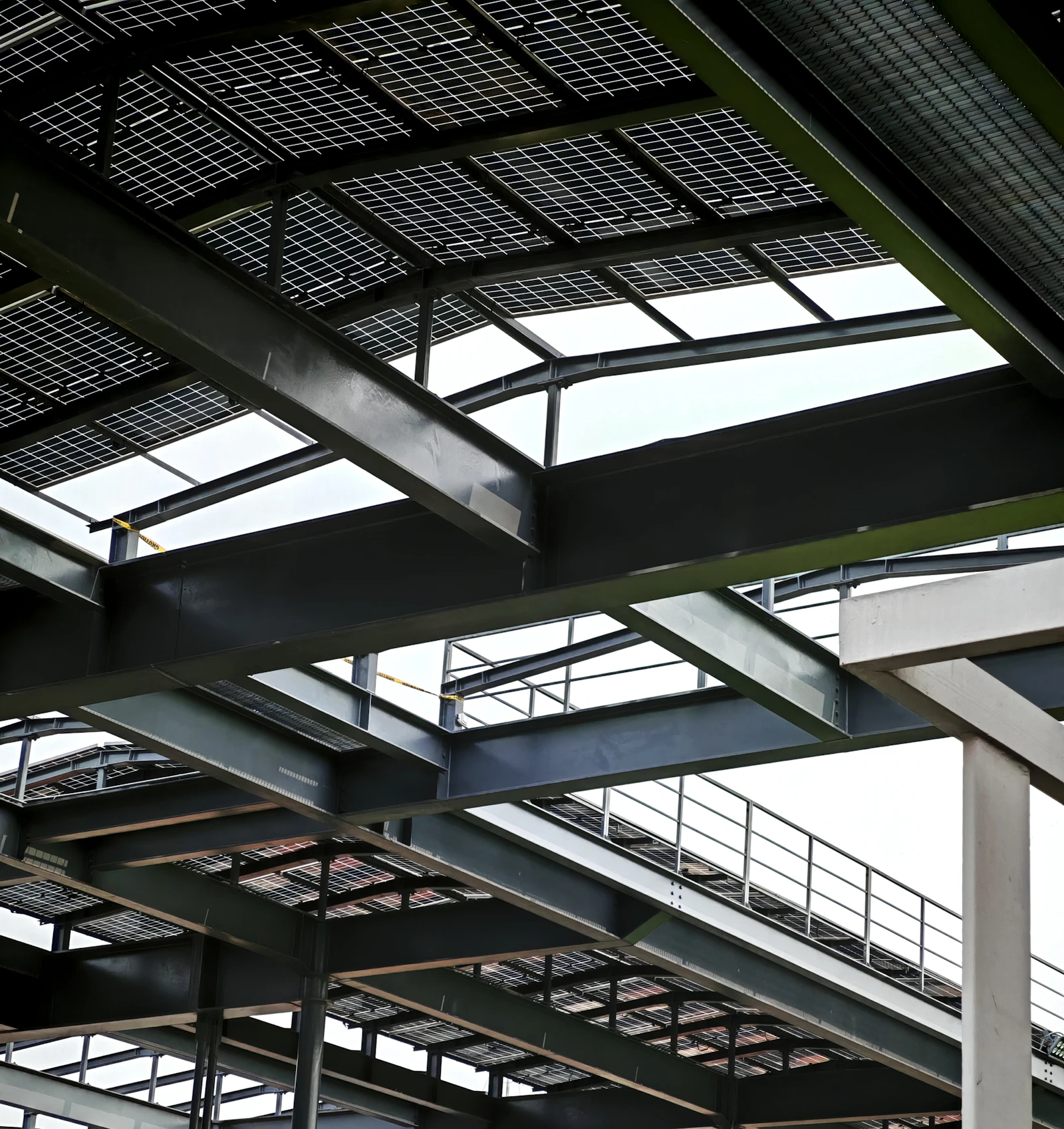
Hasnan Monir · Unsplash License
CO2 intensity by route: BF-BOF 2.2 vs DRI-EAF 1.4 vs Scrap-EAF 0.3 t CO2/t · Türkiye EAF share: 72.2% vs global 30.3% (2025) · Türkiye scrap imports: ~14 million tonnes, ~37% of global imports (Jan–Aug 2023)
"Steel is 100% recyclable" is one of the most repeated claims in construction marketing, and it happens to be true — unlike some polymers and composites, steel can be melted down and reformed indefinitely without losing its metallurgical properties. But that claim answers a different question from the one most readers assume it answers. It says nothing about how much of the steel in front of you actually came from scrap, which furnace made it, or what that route cost in carbon. Those are separate, checkable facts, and conflating them is where the marketing gets ahead of the data.
Recycled content and recyclability are not the same claim#
The American Institute of Steel Construction draws this distinction explicitly in its own sustainability guidance: recyclability is steel's capacity to be recycled repeatedly without any loss of properties — that part of the claim is unconditionally true. Recycled content is a different number: the percentage of scrap actually built into a specific piece of steel, and it depends entirely on which furnace made it. Electric arc furnace (EAF) structural shapes can reach up to 100% recycled content and average 93% in practice, with a small share of virgin material added deliberately for metallurgical balance. Basic oxygen furnace (BOF) plate and hollow sections, made mostly from virgin iron ore, typically run near 25% recycled content. Two pieces of "100% recyclable" steel, from two different furnaces, can differ by nearly 70 percentage points in what recycled content they actually contain today.
Three furnaces, three different carbon numbers#
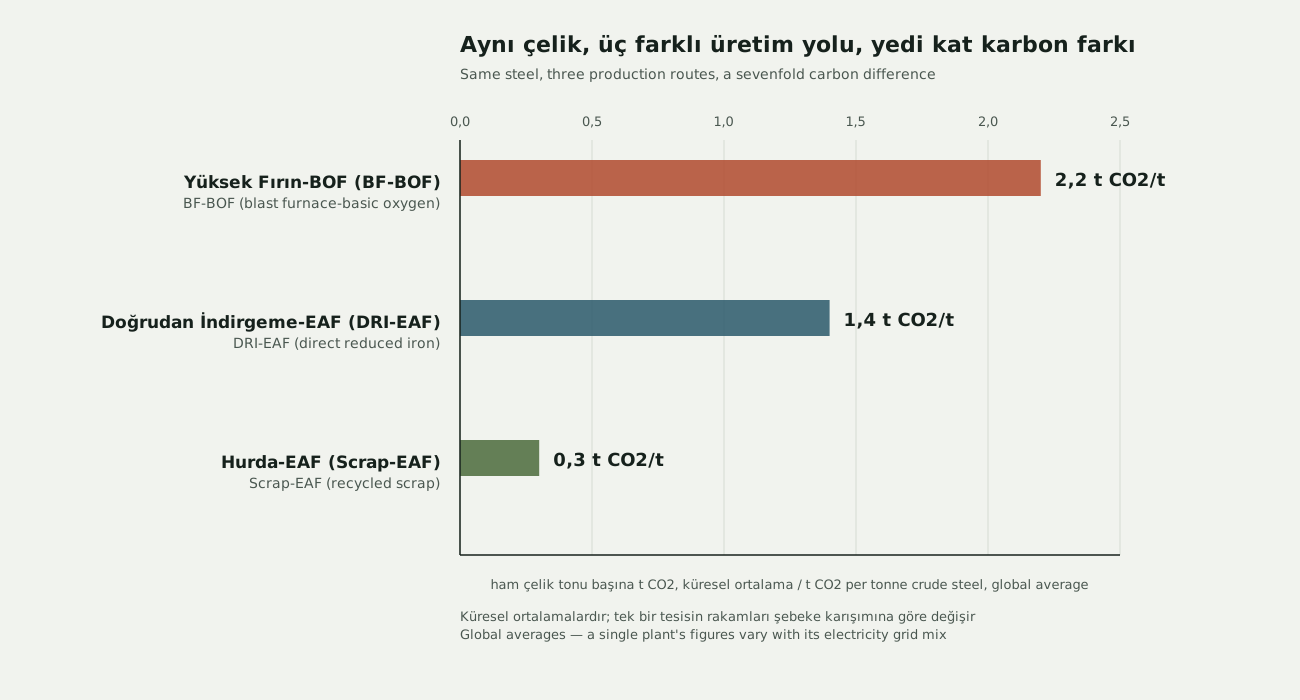
The furnace route also sets the carbon intensity, and the gap between routes is not marginal. Global average figures compiled by the Institute for Energy Economics and Financial Analysis (IEEFA) put blast-furnace/basic-oxygen-furnace (BF-BOF) production — the conventional virgin-ore route — at roughly 2.2 tonnes of CO2 per tonne of crude steel. Direct-reduced-iron feeding an electric arc furnace (DRI-EAF), a route used where scrap supply or quality is constrained, comes in at roughly 1.4 tonnes. Scrap-fed electric arc furnace (Scrap-EAF) production — steel made almost entirely by remelting existing scrap — averages roughly 0.3 tonnes: about a seventh of the BF-BOF figure.
Table 1 — Three routes, three different recycled-content and carbon profiles#
| Route | Typical recycled content | CO2 intensity | Typical product |
|---|---|---|---|
| BF-BOF | ~25%, mostly virgin ore | 2.2 t CO2/t | Flat products — sheet, plate |
| DRI-EAF | Variable — DRI plus scrap blend | 1.4 t CO2/t | Flat and long products where scrap is constrained |
| Scrap-EAF | Up to 100%, averages 93% | 0.3 t CO2/t | Long products — rebar, structural shapes |
Where the claim breaks down#
- Recycling has a contamination ceiling, not just a rate: copper and other tramp elements accumulate in scrap over successive recycling cycles and cannot be removed by remelting — they can only be diluted with virgin material, which caps how much scrap any high-grade steel product can actually absorb.
- Recycling and reuse are not the same practice, and the industry's headline recycling rate describes the former almost exclusively — see the survey data below.
- An EAF's low-carbon advantage depends on its electricity source: a scrap-EAF mill on a coal-heavy grid does not deliver the same 0.3 t CO2/t figure as one on a cleaner grid — the furnace type sets a ceiling on how clean the process can be, not a fixed outcome.
- A "recycled content" percentage printed on a mill certificate or product datasheet does not by itself tell you which furnace route made that specific batch — the AISC average figures above are industry-wide, not a guarantee for any individual delivery unless it is documented per batch.
The copper mechanism, in metallurgical terms (Dierk Raabe, Max Planck Institute for Sustainable Materials): during reheating to 1,000–1,300°C, copper rejected from the steel matrix concentrates at the scale interface; above roughly 1,085°C and once local concentration exceeds the ~8–9 wt% solubility limit at 1,100°C, it forms a liquid phase that penetrates grain boundaries and cracks the surface during hot rolling. Bulk copper above roughly 0.1 wt% starts to carry hot-shortness risk; the industry dilution target is under 0.15 wt%; some scrap-based products already exceed 0.3 wt%; and mid-century projections cited by Raabe show global average scrap copper content potentially exceeding the tolerable limit for most high-grade steel products, as the global scrap pool itself accumulates copper over successive cycles.

Recycling and reuse: a UK survey found the real ratio#
"Steel is recycled" and "steel is reused" describe two different end-of-life paths with very different environmental profiles — recycling remelts the material and starts the manufacturing process over; reuse takes the physical component and puts it into a new building with minimal reprocessing, preserving far more of the energy and carbon already invested in shaping it. The most detailed data on the actual split comes from a UK industry survey (BCSA/SCI, reported via steelconstruction.info, 2012 data): heavy structural steel sections and tubes came in at 93% recycled, 7% reused and 0% lost at end of life; across all steel construction products surveyed, the average was 92% recycled, 4% reused, 4% lost. The headline "99% recycling and reuse rate" the industry commonly cites is accurate as a combined figure — but it is overwhelmingly recycling, not reuse.
This is the same distinction this series raised for concrete and timber in File 07 (ISO 20887 and the BAMB project's "design for disassembly" work): a high combined recovery rate can coexist with almost no actual component reuse, because remelting an I-beam requires no standardised dimensions, no bolted (rather than welded) connections, and no verification of the salvaged member's residual strength — while reusing it requires all three. The barriers documented in the UK survey are the same ones found across material categories: demolition is faster than deconstruction, storage and cataloguing of salvaged sections cost money, and clients expect secondhand steel to be cheaper even though certifying it for reuse can cost more than buying new.
Türkiye: an unusually EAF-heavy producer — built partly on imported scrap#
This is one of the rarer findings in this series where Türkiye's position looks structurally favourable rather than lagging. According to the World Steel Association's own World Steel in Figures 2026 report, global crude steel production in 2025 split 69.4% BF-BOF to 30.3% EAF. Türkiye's 2025 production of 38.1 million tonnes ran the other way: 27.8% BOF to 72.2% EAF — more than double the global EAF share. Türkiye's steel industry is built almost entirely around scrap-fed EAF mini-mills, with only three integrated BF-BOF complexes in the entire country (Erdemir and İsdemir, both Oyak Group, and Kardemir, the country's sole independently integrated blast-furnace producer) accounting for roughly 12 million tonnes of the country's ~50 million tonnes of installed capacity — the remainder is EAF, dominated by producers including Tosyalı, Çolakoğlu and İçdaş, oriented mostly toward long products (rebar, wire rod, sections) that make up around 80% of output.
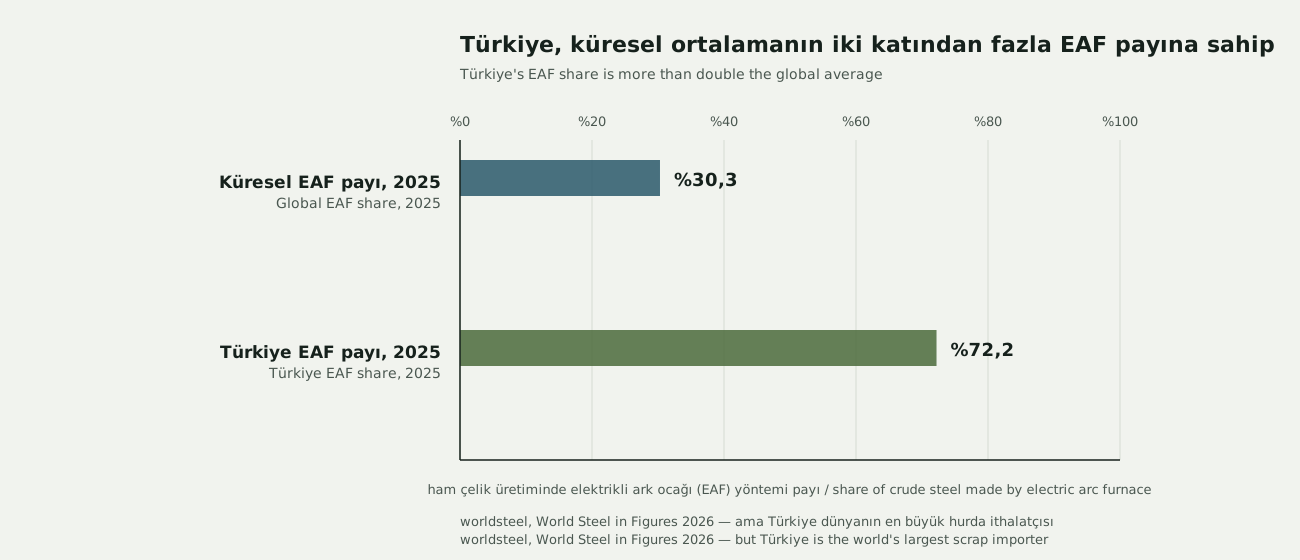
The honest counterweight to that figure: Türkiye is also the world's largest steel scrap importer. It imported roughly 14 million tonnes of scrap in just the first eight months of 2023 alone — about 37% of total global scrap imports in that period, more than double the next-largest importer. A high EAF share driven substantially by imported feedstock is a different, more import-dependent story than a high EAF share built on a fully closed domestic scrap loop — Türkiye's steel industry gets the carbon benefit of the EAF route, but that benefit currently rests in part on scrap sourced from elsewhere, not exclusively on material recovered and recirculated within the country.
None of this is an argument against steel in modular and industrialised construction — including the steel connectors, fasteners and structural framing this publisher's own SIP-based systems depend on, which carry exactly the same recycled-content-versus-recyclability distinction and the same copper-contamination ceiling as any other steel component, whatever share of the assembly is timber or panel. It is an argument for treating a "recycled steel" claim as a specific, checkable number tied to a furnace route and a batch, rather than as a blanket property of the material.
The most useful question to ask about any recycled-steel claim is not "is it recyclable?" — every ton of it is — but "what recycled content, from which furnace route, with what copper or tramp-element specification?" The first question always has a reassuring answer; the second has one that can actually be checked against a mill certificate.
Open knowledge — CC BY-SA 4.0. Copy it, correct it, cite it.
Related in the library
Share this